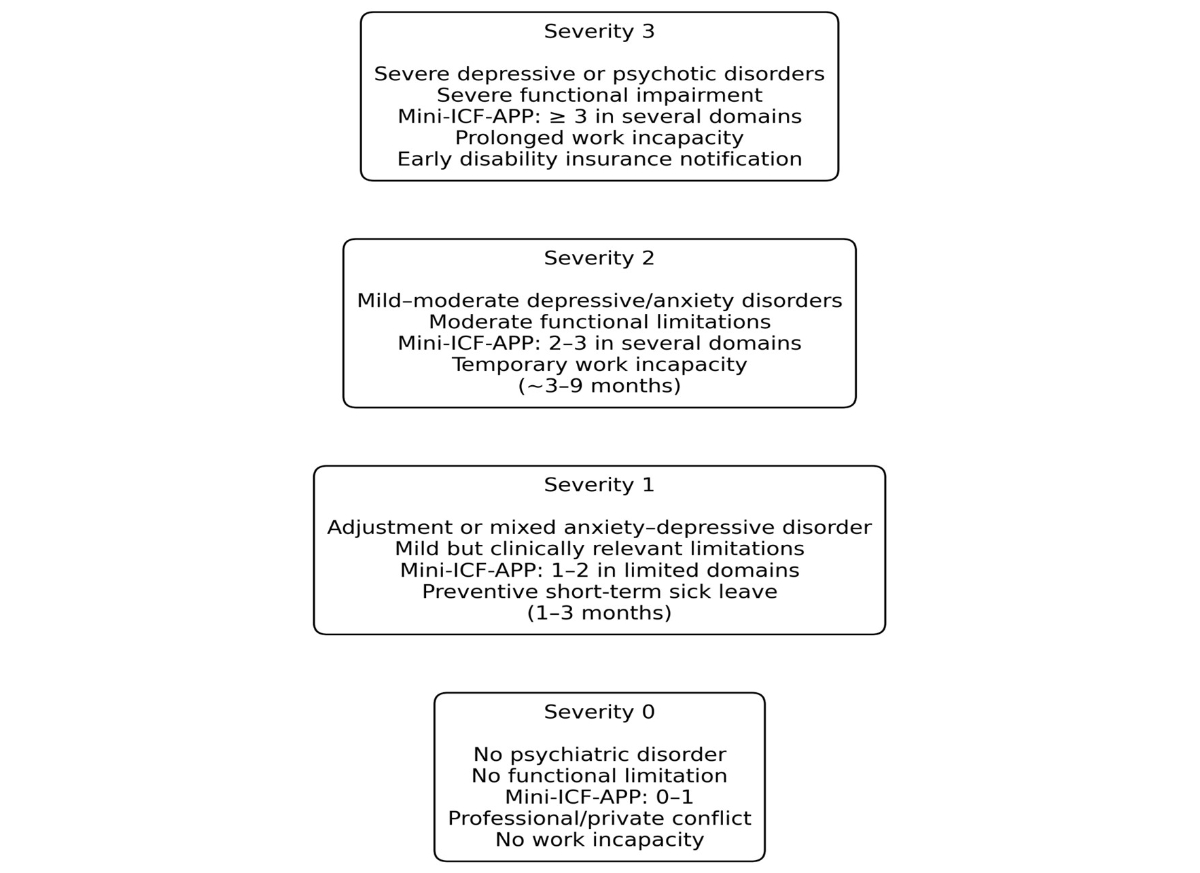
Figure 1Four-level clinical severity framework for psychiatric sickness benefit evaluations.
DOI: https://doi.org/https://doi.org/10.57187/5372
Psychiatric sick leave is not a neutral administrative act but a clinical intervention with potential benefits and harms. In everyday practice, general practitioners and psychiatrists are often asked to assess the work capacity of patients presenting with psychological distress related to occupational, interpersonal, or life stressors. These decisions are often made under time pressure, with limited information, and in contexts in which medical, occupational, social, and administrative considerations intersect. Divergent opinions among clinicians are common and usually reflect differences in clinical perspective, time horizon, and objectives rather than true diagnostic disagreement.
Internationally, psychiatric work disability assessment has progressively evolved from diagnosis-based reasoning towards multidimensional approaches that integrate functioning, participation, contextual factors, and return-to-work perspectives[1–5]. Similar principles are reflected in the WHO International Classification of Functioning, Disability and Health (ICF)[1], WHODAS-based approaches[2], ICF core sets for disability evaluation[5], and functioning-oriented psychiatric assessment models, such as the Mini-ICF-APP [3, 4]. Despite these advances, substantial variability remains among evaluators, particularly in psychiatric disability and work capacity assessments [6-9].The Mini-ICF-APP (Mini-International Classification of Functioning, Disability and Health - Assessment of Capacity and Participation), although primarily used in German-speaking countries (Germany, Switzerland, and Austria), is an internationally used measure of disability and has been translated into and validated in English, Italian, and Polish.
Unlike disability insurance evaluations aimed at determining long-term invalidity, short-term psychiatric work incapacity assessments are preventive by nature. They focus on acute functional disruption, stabilisation, therapeutic engagement, and the recovery of occupational functioning. Applying rigid or exclusively diagnosis-based reasoning to such situations may lead either to the under-recognition of clinically meaningful temporary incapacity or to prolonged withdrawal associated with deconditioning and chronicity.
Treating clinicians aim simultaneously to alleviate suffering, maintain the therapeutic alliance, prevent deterioration, and justify work incapacity decisions in a transparent and proportionate manner. Without a shared conceptual framework, assessments may become inconsistent, leading to misunderstandings among clinicians, employers, insurers, and medical advisors.
An integrated approach that combines symptom severity, functional impairment, contextual factors, and longitudinal coherence may provide a common clinical language. Such an approach does not replace diagnostic reasoning but complements it by translating diagnoses and distress into work-relevant functional impacts and time-limited expectations.
Importantly, the framework proposed here should not be interpreted as a novel psychometric scale, a validated medico-legal classification system, or a formal expert instrument. All of the individual dimensions integrated into this model are derived from previously described and peer-reviewed approaches, including ICF-based conceptualisations of functioning, biopsychosocial models of work disability, and functioning-oriented psychiatric assessment frameworks such as the Mini-ICF-APP.
The originality of this Viewpoint lies primarily in the synthesis, integration, and simplified visual operationalisation of dimensions already recognised in the international literature [1–8], with the objective of facilitating structured communication and proportionate clinical reasoning in routine psychiatric work capacity evaluations.
Clinical experience and the international occupational psychiatry literature highlight two symmetrical risks in psychiatric sick leave decisions.
The first is the under-recognition of short-term, clinically meaningful incapacity. Some individuals experience acute functional rupture in response to workplace conflict, organisational stress, interpersonal instability, or major life events. When sick leave is denied because symptoms are considered “mild” or longstanding, distress may intensify, treatment engagement may decline, and the risk of secondary complications may increase.
The second risk is the over-validation of prolonged incapacity in the absence of clearly defined functional limitations or reintegration objectives. Prolonged withdrawal from occupational functioning may reinforce avoidance behaviours, deconditioning, social isolation, and the loss of professional identity. Over time, this may paradoxically worsen the prognosis and complicate return-to-work processes.
A key clinical principle is that the duration itself may become therapeutic or harmful depending on the context, proportionality, the rehabilitation perspective, and the maintenance of occupational functioning.
In short-term work capacity assessments, the concept of decompensation is particularly relevant. Many patients have pre-existing psychological vulnerabilities – including anxious traits, attentional difficulties, autistic traits, or personality-related sensitivities – that may remain compatible with employment under stable conditions. However, under acute stress, these vulnerabilities may culminate in a sudden loss of functional equilibrium associated with genuine but potentially reversible incapacity.
Focusing solely on the chronicity of a diagnosis risks overlooking this acute rupture. Recognising decompensation allows clinicians to conceptualise work incapacity dynamically rather than exclusively in terms of a categorical diagnosis, thereby supporting time-limited interventions aimed at restoring function rather than validating chronic disability.
To support clinical reasoning and dialogue, a simple four-level framework may be useful (figure 1).
Figure 1Four-level clinical severity framework for psychiatric sickness benefit evaluations.
This framework does not replace diagnosis; rather, it translates clinical assessment into work-relevant functional impact and anticipated duration. Importantly, work capacity cannot be evaluated solely based on symptom severity, as occupational demands, level of responsibility, interpersonal exposure, cognitive load, and workplace flexibility may substantially influence functional capacity in a given professional context. The framework is intended to remain understandable and clinically applicable to general practitioners, psychiatrists, and other frontline clinicians.
Severity level 0 corresponds to situations with no clinically relevant psychiatric disorder causing functional impairment. Distress remains proportionate to contextual stressors, autonomy is preserved, and no objective limitation justifies psychiatric sick leave. Examples include workplace conflict without a characterised psychiatric disorder or adaptive emotional reactions without syndrome-level impairment.
Severity level 1 includes mild psychiatric conditions associated with a limited but clinically meaningful functional impact, such as adjustment disorders, mild mixed anxiety-depressive states, or mild anxiety presentations. Symptoms are frequently context-dependent and may be amplified by adverse occupational environments. Temporary preventive sick leave may facilitate stabilisation and therapeutic engagement, particularly when environmental modifications contribute to recovery.
Severity level 2 encompasses moderate psychiatric disorders associated with clear functional repercussions across several work-relevant domains, including moderate depressive disorders, anxiety disorders, trauma-related conditions, and comparable syndromic presentations with a demonstrable occupational impact. Temporary incapacity may be clinically indicated but should remain time-limited and be regularly re-evaluated, with a focus on recovery and reintegration.
Severity level 3 refers to severe psychiatric disorders associated with marked and pervasive impairment affecting both daily functioning and occupational participation. In such situations, prolonged incapacity and multidisciplinary coordination may become necessary.
Across all severity levels, the central element of the assessment remains global clinical coherence: the consistency among reported symptoms, observed behaviour, functional limitations, contextual information, clinical examination, and longitudinal evolution.
Coherence-based reasoning should not be interpreted as a presumption of malingering but as a safeguard against arbitrary or exclusively symptom-based conclusions. Apparent discrepancies require nuanced contextual interpretation and careful documentation rather than polarised judgements.
For general practitioners and psychiatrists, this integrated framework may help translate clinical impressions into clearer, more function-oriented reasoning: what is impaired, why now, for how long, and with what therapeutic objective. By anchoring work incapacity decisions in functioning, context, proportionality, and longitudinal coherence, clinicians may better support recovery while minimising the risk of chronicity.
The framework proposed here has not been prospectively validated, and inter-rater reliability remains to be studied. Therefore, it should not be interpreted as a standardised psychometric scale or formal expert instrument. However, its individual dimensions are derived from previously described and peer-reviewed approaches that are widely recognised internationally [5–8].
More broadly, this conceptual synthesis aims to facilitate communication among clinicians and medical stakeholders confronted with increasingly complex psychiatric work capacity evaluations across healthcare systems.
The authors did not receive any financial support for the preparation of this manuscript.
All authors have completed and submitted the International Committee of Medical Journal Editors form for disclosure of potential conflicts of interest. No potential conflict of interest related to the content of this manuscript was disclosed.
1. World Health Organization. International Classification of Functioning, Disability and Health (ICF). Geneva: World Health Organization; 2001.
2. Üstün TB, Kostanjsek N, Chatterji S, Rehm J, editors. Measuring Health and Disability: Manual for WHO Disability Assessment Schedule WHODAS 2.0. Geneva: World Health Organization; 2010.
3. Linden M, Baron S. Das "Mini-ICF-Rating für psychische Störungen (Mini-ICF-P)". Ein Kurzinstrument zur Beurteilung von Fähigkeitsstörungen bei psychischen Erkrankungen [The "Mini-ICF-Rating for Mental Disorders (Mini-ICF-P)". A short instrument for the assessment of disabilities in mental disorders]. Rehabilitation (Stuttg). 2005 Jun;44(3):144-51. German. doi: . PMID: 15933950.
4. Molodynski A, Linden M, Juckel G, Yeeles K, Anderson C, Vazquez-Montes M, et al. The reliability, validity, and applicability of an English language version of the Mini-ICF-APP. Soc Psychiatry Psychiatr Epidemiol. 2013 Aug;48(8):1347–54.
5. Brage S, Donceel P, Falez F; Working Group of the European Union of Medicine in Assurance and Social Security. Development of ICF core set for disability evaluation in social security. Disabil Rehabil. 2008;30(18):1392–6.
6. Schandelmaier S, Fischer K, Mager R, Hoffmann-Richter U, Leibold A, Bachmann MS, et al. Evaluation of work capacity in Switzerland: a survey among psychiatrists about practice and problems. Swiss Med Wkly. 2013 Dec;143(4950):w13890.
7. Schandelmaier S, Leibold A, Fischer K, Mager R, Hoffmann-Richter U, Bachmann MS, et al. Attitudes towards evaluation of psychiatric disability claims: a survey of Swiss stakeholders. Swiss Med Wkly. 2015 Aug;145(3334):w14160.
8. Bachmann M, de Boer W, Schandelmaier S, Leibold A, Marelli R, Jeger J, et al. Use of a structured functional evaluation process for independent medical evaluations of claimants presenting with disabling mental illness: rationale and design for a multi-center reliability study. BMC Psychiatry. 2016 Jul;16(1):271.
9. Damsa C, Adam E, Lazignac C, Mihai A, Stamatoiu D. Analysis of inter-judge concordance for the realization of psychiatric expertise in the use of guidelines. Bull Soc Sci Med Grand Duche Luxemb. 2009;(1):45-56. French. PMID: 19514175.