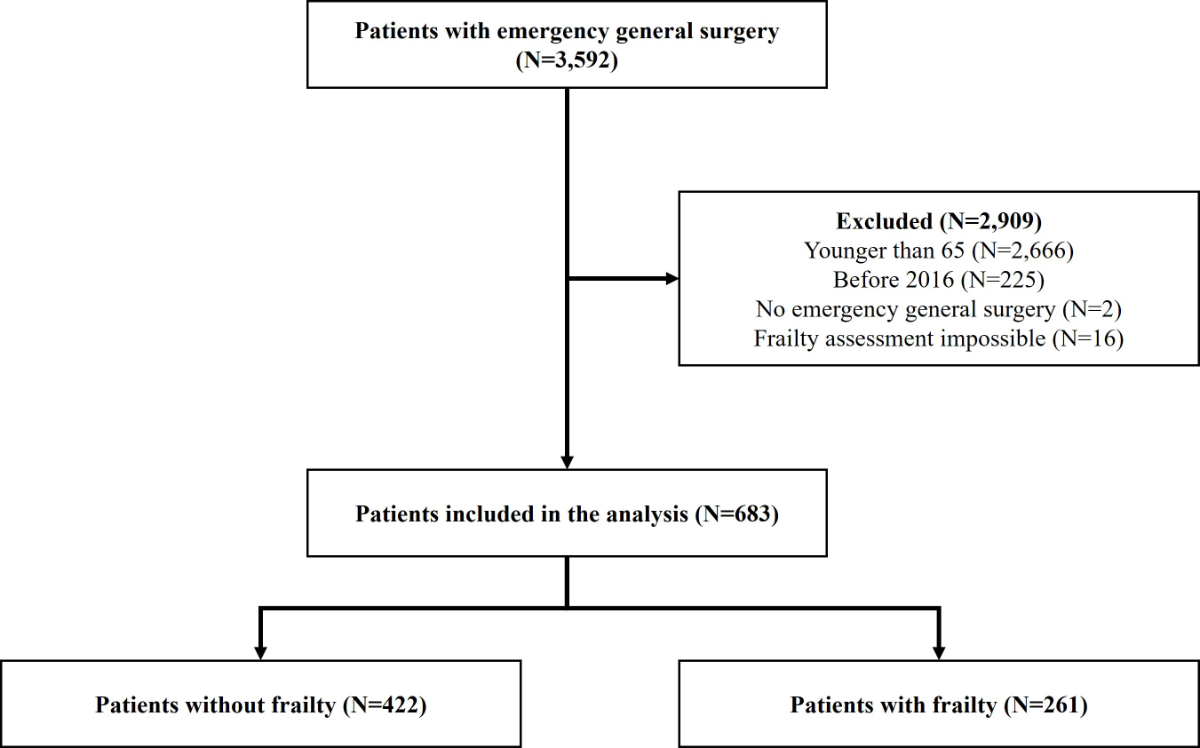
Figure 1 Flowchart.
DOI: https://doi.org/https://doi.org/10.57187/5114
Although emergency general surgery accounts for just 10% of all general surgeries, it is responsible for nearly half of all deaths and over a quarter of complications [1]. Mortality after emergency general surgery is estimated to be five times higher than after elective surgeries [2]. Older adults are particularly impacted, comprising more than 30% of emergency general surgery cases [3]. Age is consistently linked to worse outcomes, such as increased short-term mortality and prolonged hospitalisation [4–7]. Yet, age alone is insufficient to predict individual outcomes, as more than 60% of patients over 80 survive the first 30 days following surgery [8].
Thus, interest has grown in alternative predictors like frailty and functional status. Several frailty measures show a strong association with poor outcomes in emergency general surgery [9–11]. Among them, the Clinical Frailty Scale (CFS), developed by Rockwood, has gained attention for its ease of use and strong prognostic value [12, 13]. Studies in the United Kingdom have found that patients with frailty experience higher mortality at multiple time points, longer admissions and greater care needs at discharge [14–16]. Similar findings were reported in Spain, where frailty correlated with 30-day mortality and complications. The CFS stands out as a suitable tool for use in emergency departments due to its practicality and accuracy [17, 18].
To date, no research has explored this relationship in Switzerland. Some studies have demonstrated the association between frailty and adverse outcomes in the Swiss general population [19]. However, its impact in emergency general surgery remains unexplored, especially within the Swiss health system’s unique structure, characterised by dense hospital networks, high physician availability and relatively lower nurse-to-bed ratios. Identifying frailty early could improve risk assessment, inform shared decision-making and support tailored perioperative care strategies. Incorporating frailty assessments, such as the CFS, into predictive tools may further enhance outcome prediction.
The overall goal of the present study was to assess the association between frailty and outcomes in older emergency general surgery patients treated in a Swiss university hospital. Our specific objectives were to estimate the association between frailty and (1) 1-year mortality, (2) major complications, (3) length of stay and (4) discharge to a location other than home.
The study was a secondary analysis of a cohort of emergency general surgery patients from Hôpitaux Universitaires Genève (HUG; Geneva University Hospitals) [7]. The initial cohort comprised all adult patients who presented to the emergency department (ED) between 2015 and 2019 and who required emergency general surgery within 72 hours of ED presentation. Patients admitted primarily for psychiatric reasons and those who left without consultation were excluded. Data were obtained through electronic data extraction and medical chart review.
Patients were included if they presented to the HUG ED between 1 January 2016 and 31 December 2019, were aged 65 or over and underwent emergency general surgery. Emergency general surgery was defined as one of the following procedures performed on a non-elective basis within 72 hours of admission: appendectomy, cholecystectomy, laparotomy, lysis of adhesions, large bowel resection, small bowel resection or peptic ulcer repair. These procedures were classified as low-risk (appendectomy, cholecystectomy) or high-risk (laparotomy, lysis of adhesions, large bowel resection, small bowel resection, peptic ulcer repair) [20]. Patients were identified using CHOP (Swiss Classification of Surgical Interventions) codes, the Swiss equivalent of the International Classification of Diseases Procedure Coding System (ICD-PCS).
The exposure variable was frailty, assessed using the Clinical Frailty Scale (CFS). Frailty status was retrospectively determined through a review of electronic medical records, based on ED physician reports and follow-up notes from physicians, nurses and physiotherapists, following predefined criteria (case report form in original French available in supplementary information 1 in the appendix). The assessment aimed to evaluate frailty status during the month preceding hospital admission.
Previous studies demonstrate that frailty assessment via medical chart review is comparable to patient or family interviews [21]. To enhance the reliability of the assessment, three trained, unblinded reviewers (CAF, CS, KVD) independently evaluated a random sample of 10% of the charts. Discrepancies were resolved through consensus discussions [22]. Owing to an initial inter-rater agreement below the predefined threshold (80%), the extraction form was refined, CFS levels 2 and 3 were merged and an additional 5% of charts were reviewed. Following this adjustment, agreement improved, and each of the three reviewers independently assessed a third of the remaining charts. All abstractors were medical doctors with experience in emergency medicine and completed an e-learning programme on frailty and the CFS [23].
The primary outcome was 1-year mortality, defined as death occurring within one year of the surgical procedure. One-year mortality was collected electronically. When a patient’s death was documented in the electronic health record, the recorded date of death was used. If death was not documented, patients who had a hospital visit more than one year after surgery were considered alive at one year. For the remaining patients, 1-year mortality was considered missing. Secondary outcomes included in-hospital major complications, hospital length of stay and discharge to a location other than home. Major complications were defined as Clavien-Dindo grade ≥3, indicating complications requiring intervention (Grade 3) or ICU admission (Grade 4), or resulting in death (Grade 5) [24]. Hospital length of stay was measured from the time of admission to discharge, excluding transfers to rehabilitation or other non-acute care facilities. Discharge to a location other than home included discharge to a post-acute care facility, a rehabilitation facility or a nursing home.
Triage level in the emergency department was categorised according to the Swiss Emergency Triage Scale: Level 1 for life-threatening emergencies needing immediate care; Level 2 for urgent conditions requiring assessment within 20 minutes; Level 3 for semi-urgent situations requiring assessment within 2 hours; and Level 4 for non-urgent presentations [25]. Additional collected variables have been previously described in detail [7].
Variables were extracted electronically from the hospital data warehouse. This system contains comprehensive information from current and previous hospitalisations, including physicians’ and nurses’ notes, admission and discharge summaries, orders, imaging and results, laboratory tests and vital signs. For the CFS assessment, medication count and complications, data were collected and managed using REDCap (Research Electronic Data Capture) hosted at HUG [26, 27]. REDCap is a secure, web-based software platform designed to support data capture for research studies, providing 1) an intuitive interface for validated data capture; 2) audit trails for tracking data manipulation and export procedures; 3) automated export procedures for seamless data downloads to common statistical packages; and 4) procedures for data integration and interoperability with external sources. A standardised case report form was developed, pretested and refined before initiating the final chart review process (case report form in original French available in supplementary information 1 in the appendix).
Statistical analyses were performed using Stata version 17 (StataCorp, College Station, TX, USA).
The distribution of the CFS was described for the overall patient population and within key subgroups defined by sex, age and level of care prior to admission. Baseline characteristics were summarised using means and standard deviations for normally distributed continuous variables, and medians with interquartile ranges (IQR) for skewed distributions. Categorical variables were reported as counts and proportions. To align our approach with the majority of published studies on this topic, patients were stratified into two groups: those without frailty (CFS 1–4) and those with frailty (CFS 5–9). Comparisons between groups were conducted using standardised mean differences (SMD).
Outcomes were analysed according to frailty as a binary variable (without vs with frailty). For binary outcomes, counts and proportions were reported, and binary logistic regression was used to estimate crude odds ratios (OR) with 95% confidence intervals (CI). For hospital length of stay, a skewed continuous variable, geometric means and 95% CIs were reported. Multivariable regression models were then used to assess the adjusted associations between frailty and each outcome. For length of stay, linear regression analysis was used after log transformation and estimated regression coefficients were exponentiated to yield the adjusted relative difference, expressed as a percentage with corresponding 95% CI. The assumptions for linear regression were assessed, including linearity, homoscedasticity, normality of residuals and absence of multicollinearity. Covariates adjusted for in the multivariable models were age, sex, triage level and the number of acute hospitalisations in the past year. These were selected a priori, based on existing literature, clinical judgement and data availability. These variables were considered likely to influence both frailty status and clinical outcomes. To account for potential non-linear associations, associations with continuous covariates were modelled using restricted cubic splines, with three knots at the 10th, 50th and 90th percentiles [28]. A secondary analysis was conducted treating frailty as a multilevel categorical variable. A sensitivity analysis was performed excluding patients with a CFS level of 9, as these individuals are generally considered palliative and are expected to have a high mortality risk independent of surgery. Finally, we conducted a post hoc survival analysis to further explore the association between frailty and mortality over time. Time-to-event data were analysed using a Cox proportional hazards regression model. The model included the same covariates as those used in the primary analysis. The proportional hazards assumption was assessed using Schoenfeld residuals and the corresponding statistical test. Survival probabilities were estimated using the Kaplan–Meier method and graphically displayed with Kaplan–Meier curves.
For the primary outcome, effect modification was assessed using interaction terms based on sex, risk of the procedure, time of admission (night vs day) and ED C-reactive protein (CRP) level (<40 vs ≥40 mg/L). These factors were selected because acuity may modify the association between frailty and clinical outcomes [13].
A significance level of 5% was applied for all statistical tests.
We estimated that a sample size of 374 patients would be sufficient to detect a difference in the primary outcome, with 80% power, assuming a risk ratio of 3.0, a mortality rate of 5% in patients without frailty and a frailty prevalence of 33%. However, to ensure an adequate number of events for adjusted analyses with 10–20 degrees of freedom [29], we chose to include approximately 650 patients, corresponding to a 4-year inclusion period.
For missing exposure data, patients were excluded if frailty could not be assessed at all. If the exact frailty level was unknown but group classification (with vs without frailty) was possible, patients were included in both analyses: assigned to their frailty group in the primary analysis and considered as a missing category in the secondary analysis.
For missing outcome data, patients were excluded from the primary analysis. A sensitivity analysis was conducted under three assumptions: (1) all patients died; (2) all patients survived; and (3) patients with frailty survived while patients without frailty died, representing the weakest possible association.
The study was conducted at HUG in compliance with Good Clinical Practice guidelines and the principles outlined in the Declaration of Helsinki (2002).
The protocol was submitted for approval to the Commission Cantonale d'Éthique de la Recherche, the Ethics Committee overseeing all research projects at HUG. The Committee approved the protocol on 23 August 2021 (Project ID: 2021-01498). Moreover, given that the study was retrospective and would use previously collected data, the Committee granted a waiver for patient consent. Consequently, only patients who had explicitly refused the use of their data were excluded from the study.
The initial cohort was registered on the Open Science Framework (DOI: 10.17605/OSF.IO/TRU4N). The protocol for the secondary analysis has not been published and is available on request from the corresponding author. The dataset and the Stata code supporting the findings are publicly available on the Open Science Framework (DOI: 10.17605/OSF.IO/8K7YN). This study is reported in accordance with STROBE (Strengthening the Reporting of Observational Studies in Epidemiology) guidelines [30].
Among the 3592 patients initially screened, 2891 were excluded, mostly because they were younger than 65 years. Chart review identified two patients without emergency general surgery who were therefore excluded. Additionally, the CFS level could not be assessed in 16 patients (2.3%), leading to their exclusion. Thus, 683 patients were ultimately included in the analysis (figure 1).
Figure 1 Flowchart.
The median age was 76 years, and 52.7% of the patients were female (table 1). A total of 38 patients (5.6%) were living in a nursing home prior to hospitalisation, and the median number of medications was 4 (IQR: 2–7). Overall, 341 patients (46%) were admitted to the emergency department by ambulance, and 52.4% of the patients had an emergency department triage level of 2.
Table 1Patient characteristics.
| All patients (n = 683) | Patients with frailty (n = 261) | Patients without frailty (n = 422) | SMD | |
| Female – n (%) | 360 (52.7%) | 139 (53.3%) | 221 (52.4%) | 0.018 |
| Age (years) – median (IQR) | 76 (71–83) | 82 (75–89) | 74 (69–79) | 0.928 |
| Living in a nursing home before hospitalisation – n (%) | 38 (5.6%) | 38 (14.6%) | 0 (0.0%) | 0.584 |
| Acute hospitalisation in the previous year – n (%) | 0.724 | |||
| … 0 | 427 (62.5%) | 110 (42.2%) | 317 (75.1%) | |
| … 1–2 | 192 (28.1%) | 107 (41.0%) | 85 (20.1%) | |
| … >2 | 64 (9.4%) | 44 (16.9%) | 20 (4.7%) | |
| Emergency department visits in the previous year – n (%) | 0.607 | |||
| … 0 | 403 (59.0%) | 109 (41.8%) | 294 (69.7%) | |
| … 1–2 | 211 (30.9%) | 107 (41.0%) | 104 (24.6%) | |
| … >2 | 69 (10.1%) | 45 (17.2%) | 24 (5.7%) | |
| Admission by ambulance or equivalent – n (%) | 341 (46.0%) | 173 (66.3%) | 141 (33.4%) | 0.696 |
| Emergency department triage levela – n (%) | 0.311 | |||
| … 1 (highest acuity) | 39 (5.7%) | 21 (8.1%) | 18 (4.3%) | |
| … 2 | 358 (52.4%) | 152 (85.2%) | 206 (48.8%) | |
| … 3 | 277 (40.6%) | 87 (33.3%) | 190 (45.0%) | |
| … 4 (lowest acuity) | 9 (1.3%) | 1 (0.4%) | 8 (1.9%) | |
| Night admission (6pm – 7am) – n (%) | 262 (38.4%) | 95 (36.4%) | 167 (39.6%) | 0.065 |
| Weekend admission – n (%) | 149 (21.8%) | 54 (20.7%) | 95 (22.5%) | 0.044 |
| Body mass index (kg/m2) – mean±SD | 25.8±5.6 | 25.3±5.4 | 26.0±5.4 | 0.082 |
| ED vital signs | ||||
| … Systolic blood pressure (mm Hg) – mean±SD | 137±25 | 135±25 | 138±24 | 0.101 |
| … Diastolic blood pressure (mm Hg) – mean±SD | 78±16 | 77±17 | 79±15 | 0.142 |
| … Mean arterial pressure <65 mm Hg – n (%) | 21 (3.1%) | 9 (3.5%) | 12 (2.9%) | 0.036 |
| … Heart rate (bpm) – mean±SD | 89±19 | 90±18 | 89±19 | 0.042 |
| … Temperature (°C) – mean±SD | 37.1±0.8 | 37.2±0.9 | 37.1±0.8 | 0.142 |
| Laboratory values – median (IQR) | ||||
| … Creatinine (umol/l) | 86.5 (69–115) | 97 (73.5–132) | 83 (68–104) | 0.195 |
| … Haemoglobin (g/l) | 135 (121–147) | 130 (114–143) | 136 (125–148) | 0.381 |
| … Leucocytes (×109/l) | 11.8 (8.8–15.8) | 11.7 (8.7–16.9) | 11.8 (8.9–15.4) | 0.138 |
| … C-reactive protein (mg/l) | 58.9 (10.6–174.9) | 73.45 (16.2–196.1) | 49.2 (8.5–145.6) | 0.179 |
| Number of drugs – median (IQR) | 4 (2–7) | 6 (3–9) | 3 (1–5) | 0.750 |
| Diabetes – n (%) | 108 (15.8%) | 48 (18.4%) | 60 (14.2%) | 0.113 |
| Hypertension – n (%) | 366 (53.6%) | 166 (63.6%) | 200 (47.4%) | 0.331 |
| History of myocardial infarction – n (%) | 70 (10.3%) | 31 (11.9%) | 39 (9.2%) | 0.086 |
| Chronic obstructive pulmonary disease – n (%) | 36 (5.3%) | 23 (8.8%) | 13 (3.1%) | 0.244 |
| Cognitive impairment – n (%) | 53 (7.8%) | 47 (18.0%) | 6 (1.4%) | 0.583 |
| Emergency department length of stay (hours) – median (IQR) | 6.9 (4.5–10.7) | 7.5 (5.0–10.8) | 6.6 (4.2–10.7) | 0.167 |
| Time to operating room (hours) – median (IQR) | 16.0 (7.7–33.7) | 15.0 (7.0–30.8) | 16.9 (8.3–36.5) | 0.112 |
| High-risk interventionb – n (%) | 328 (48.0%) | 149 (57.1%) | 179 (42.4%) | 0.296 |
bpm: beats per minute; IQR: interquartile range; SD: standard deviation; SMD: standardised mean difference.
a The emergency department triage level is based on the Swiss Emergency Triage Scale.
b High-risk interventions include laparotomy, lysis of adhesions, large bowel resection, small bowel resection and peptic ulcer repair.
Frailty was identified in 261 patients, corresponding to a prevalence of 38.2% (95% CI: 34.6–41.9%). The exact frailty level could not be assigned for 100 patients (14.6%) (table S1 in the appendix). Patients with frailty were older, had more previous hospitalisations or emergency department visits, and presented with a more-urgent triage level. No clinically relevant differences were observed in admission time, body mass index, vital signs or laboratory results (table 1).
Among the 652 (95.5%) patients without missing data for the outcome, the overall 1-year mortality was 14.1% (95% CI: 11.6–17.0%) (table 2). It was higher in patients with frailty compared to those without (25.6% vs 6.6%; OR: 4.9 [95% CI: 3.0–7.9]). After adjustment for age, sex, triage level and previous hospitalisations, the association remained significant (adjusted OR: 3.0 [95% CI: 1.7–5.1]).
Table 2Crude and adjusted associations between frailty and outcomes after emergency general surgery.
| All patients (n = 683) | Patients with frailty (n = 261) | Patients without frailty (n = 422) | Crude associationa (95% CI) | Adjusted associationa,b (95% CI) | ||
| Primary outcome | 1-year mortality – n (%) | 92/652 (14.1%) | 66/258 (25.6%) | 26/394 (6.6%) | 4.8 (3.0–7.9) | 3.0 (1.7–5.1) |
| Secondary outcomes | Major complications – n (%) | 155 (22.7%) | 84 (32.2%) | 71 (16.8%) | 2.3 (1.6–3.4) | 2.3 (1.5–3.6) |
| Hospital length of stay (day) – mean (95% CI)c | 9.3(8.7–9.9) | 12.8 (11.6–14.1) | 7.6 (7.0–8.2) | +68.0% (48.2–90.4) | +46.4% (26.8–69.0) | |
| Discharge to a location other than home – n (%)d | 173/647 (26.7%) | 102/238 (42.9%) | 71/409 (17.4%) | 3.6 (2.5–5.1) | 2.1 (1.4–3.2) |
CI: confidence interval.
a Reported as odds ratios for binary outcomes or percentage change for hospital length of stay.
b Analyses were adjusted for age, sex, emergency department triage level and number of previous hospitalisations. Age was modelled using restricted cubic splines. Emergency department triage level was defined according to the Swiss Emergency Triage Scale.
c Geometric mean.
d Among patients alive at discharge and not in a nursing home before hospitalisation.
A total of 155 patients (22.6%) experienced a major complication. This included the need for a new intervention in 34.8% of them (54/155), an ICU admission in 47.1% (73/155) or death in 18.1% (28/155). Patients with frailty were more likely to experience major complications (32.2% vs 16.8%, aOR: 2.3 [95% CI: 1.5–3.6]) (table 2). They also had a longer hospital stay (12.8 vs 7.6 days, +46.4% [95% CI: 26.8–69.0%]) and were more often discharged to a location other than home (42.9% vs 17.4%, aOR: 2.1 [95% CI: 1.4–3.2]).
In the secondary analysis using the CFS as a multilevel categorical variable (table S2 in the appendix), we observed a progressive increase in odds of 1-year mortality with higher levels of frailty, with odds ratios from 3.4 for CFS 2-3 to 67 for CFS 8. In the sensitivity analysis addressing missing outcome data, the association between frailty and mortality remained statistically significant under all assumptions (table S3 in the appendix). The odds ratio was 1.8 (95% CI: 1.2–2.9) when assuming all patients with missing values died, 3.1 (95% CI: 1.8–5.3) when assuming all survived and 1.7 (95% CI: 1.1–2.7) when assuming patients without frailty died and patients with frailty survived. In the analysis excluding patients with a CFS score of 9, the adjusted OR was 2.6 (95% CI: 1.2–5.9). In the post hoc survival analysis, the Cox proportional hazards model showed that frailty was independently associated with the outcome, with an adjusted hazard ratio (HR) of 3.0 (95% CI: 1.7–5.2). The Kaplan–Meier survival curves are presented in the appendix (figure S1). Finally, in the subgroup analysis, the effect was consistent across the different subgroup analyses performed (figure 2), although the association appeared slightly stronger for low-risk procedures than for high-risk procedures. Mortality stratified by frailty level and risk of procedure is summarised in table S4 in the appendix.
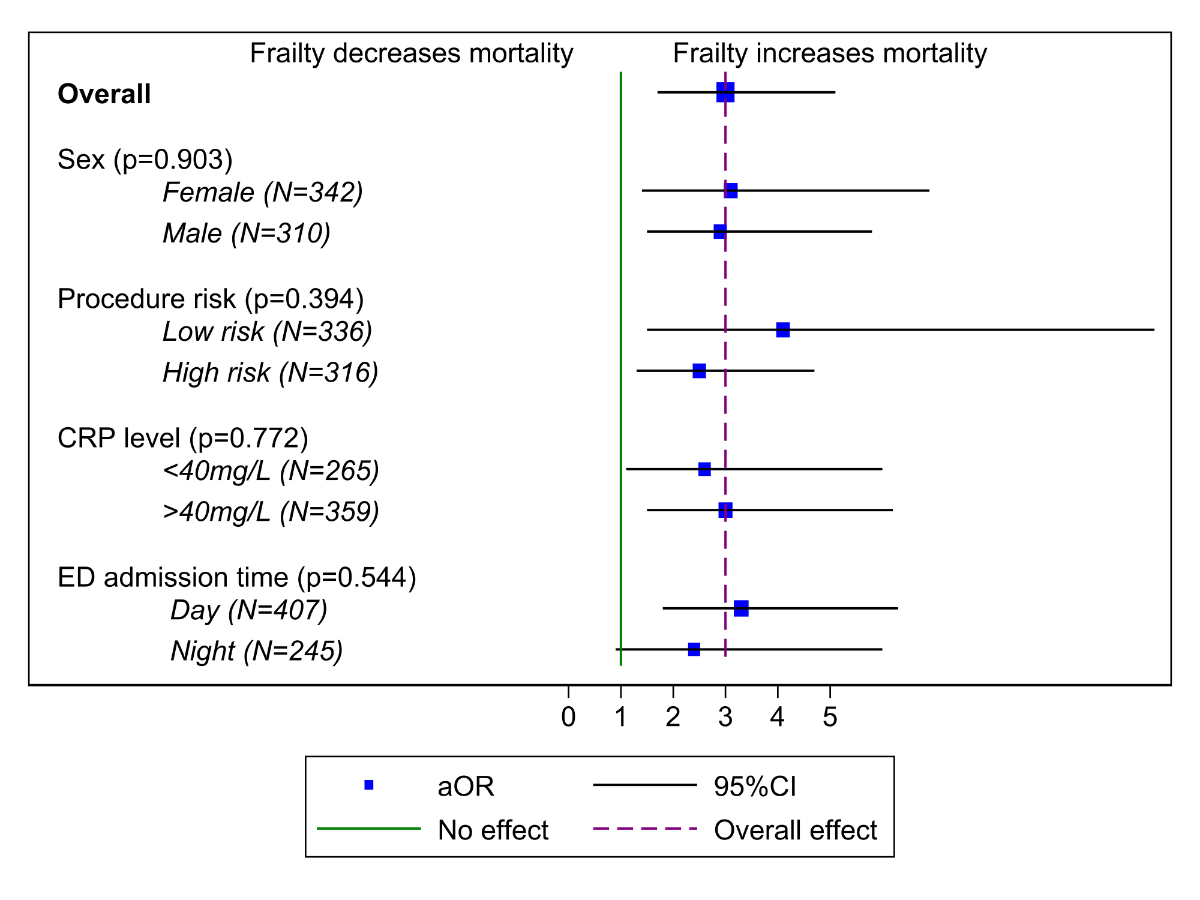
Figure 2 Subgroup analysis for the primary outcome. aOR: adjusted odds ratio; CI: confidence interval; CRP: C-reactive protein; ED: emergency department.
In this observational study, we reported an association between frailty and 1-year mortality among older patients requiring emergency general surgery. Patients with frailty were more frequently discharged to a location other than home, experienced major complications more often and had longer hospital stays.
This study is consistent with previous research in the field, although the strength of the association between frailty and 1-year mortality varies across studies. This can be explained by differences in patient populations, frailty measures and statistical adjustments [9, 15, 31]. Despite this variability, evidence consistently shows that frailty increases the risk of poor outcomes after emergency general surgery. Notably, the association appeared stronger in low-risk procedures, consistent with findings from the study by Castillo-Angeles et al. regarding 30-day mortality [32]. Although this difference did not reach statistical significance, it supports the importance of screening all patients, not just those undergoing high-risk procedures. Finally, this study confirms that age alone should not be considered a determinant of mortality [33].
In addition to 1-year mortality – which may not be the most relevant outcome for older adults –, patients with frailty experienced poorer short-term outcomes. The increased risk of major complications observed in our study is consistent with previous findings [34–36] and prolonged hospitalisation has also been reported in several studies [37]. Furthermore, our results showed a 2-fold increase in the risk of discharge to a location other than home among frail patients, confirming that frailty increases dependency [38, 39]. In some cases, surgery and aggressive life-prolonging interventions may do more harm than good [40]. For many older adults, longevity is not the primary goal. Instead, being surrounded by loved ones, maintaining comfort and avoiding pain are often considered more important [41]. Therefore, open communication regarding care options and their outcomes is crucial to support the shared decision-making process with patients and caregivers, highlighting that the impact of emergency general surgery extends beyond mortality alone.
Some limitations should be acknowledged. First, the CFS was assessed retrospectively from medical records, which may have led to exposure misclassification. However, this approach has been validated, reviewers were trained and the extraction form was adapted to enhance data quality. Missing mortality information represents another limitation. One-year mortality was missing for less than 5% of patients, most of whom (90%) were non-frail, indicating non-random missingness. Findings were robust to extreme assumptions in sensitivity analyses. It should be noted that patients were initially selected using discharge diagnostic and intervention codes. This approach may have led to inappropriate inclusion or exclusion of some patients. Nevertheless, only two cases of inappropriate inclusion were identified during the chart review. Residual confounding may remain. While we included variables felt to be at high risk for confounding, it is possible others may exist which could influence our results. One last point to consider is that the results of this study may underestimate the true association, as patients with greater frailty were likely not offered surgery and therefore excluded from the cohort. Despite these limitations, several strengths should be highlighted. First, the large sample size allows for the use of multivariable regression models with a reduced risk of overfitting. In addition, the use of a standardised data extraction form, which was refined following pilot training on a subset of the study population, enhances the internal validity of the study.
The findings of this study may contribute to informing both clinical practice and future research directions. From a clinical perspective, these results may assist in informing patients before surgery, enabling a more accurate estimation of individual risk and prognosis. Routine incorporation of the CFS into the assessment of older patients considered for emergency general surgery may help guide decision-making and care planning [42]. Our results could also support tailoring specific interventions or, when appropriate, postponing surgery. Recognising when to avoid surgery can be more challenging than deciding when to proceed. Identifying frailty could assist in developing a plan focused on the individual rather than just the condition [43].
From a research perspective, given that the CFS appears to be a potential predictor of outcomes after emergency general surgery, it might be integrated into clinical prediction models. Another relevant research question would be to explore whether frailty level influences the decision for non-surgical management in older patients requiring emergency general surgery. Finally, it would be important to assess the association between frailty level and patient-centred outcomes, such as quality of life, after emergency surgery.
Frailty is associated with adverse outcomes in older adults undergoing emergency general surgery. Beyond mortality, frailty is associated with higher complication rates, longer hospitalisation and increased risk of discharge to a location other than home. These findings support the routine use of the Clinical Frailty Scale in emergency settings to enhance perioperative risk assessment and facilitate shared decision-making with patients and their caregivers.
The data and the code supporting the findings of this study are freely available online on the Open Science Framework (OSF) at https://www.doi.org/10.17605/OSF.IO/8K7YN.
Authors’ contributions (based on CREDIT taxonomy): Conceptualization: CAF, DM, FR, DE, MT, JP. Data curation: CAF, CS, KVD. Formal analysis: CAF. Funding acquisition : CAF. Investigation: CAF. Methodology: CAF, MT, JP. Project administration : CAF. Software: CAF. Supervision: JP. Validation: CAF. Visualiszation: CAF. Writing – original draft : CAF. Writing – review & editing : CAF, CS, KVD, RR, DM, FR, DE, MT, JP.
This study did not receive any specific grants from funding agencies in the public, commercial or not-for-profit sectors.
All authors have completed and submitted the International Committee of Medical Journal Editors form for disclosure of potential conflicts of interest. No potential conflict of interest related to the content of this manuscript was disclosed.
1. To KB, Kamdar NS, Patil P, Collins SD, Seese E, Krapohl GL, et al.; Michigan Surgical Quality Collaborative (MSQC) Emergency General Surgery Study Group and the MSQC Research Advisory Group. Acute Care Surgery Model and Outcomes in Emergency General Surgery. J Am Coll Surg. 2019 Jan;228(1):21–28.e7.
2. Havens JM, Peetz AB, Do WS, Cooper Z, Kelly E, Askari R, et al. The excess morbidity and mortality of emergency general surgery. J Trauma Acute Care Surg. 2015 Feb;78(2):306–11.
3. McVeigh TP, Al-Azawi D, O’Donoghue GT, Kerin MJ. Assessing the impact of an ageing population on complication rates and in-patient length of stay. Int J Surg. 2013;11(9):872–5.
4. Howes TE, Cook TM, Corrigan LJ, Dalton SJ, Richards SK, Peden CJ. Postoperative morbidity survey, mortality and length of stay following emergency laparotomy. Anaesthesia. 2015 Sep;70(9):1020–7.
5. Cook TM, Day CJ. Hospital mortality after urgent and emergency laparotomy in patients aged 65 yr and over. Risk and prediction of risk using multiple logistic regression analysis. Br J Anaesth. 1998 Jun;80(6):776–81.
6. Svenningsen P, Manoharan T, Foss NB, Lauritsen ML, Bay-Nielsen M. Increased mortality in the elderly after emergency abdominal surgery. Dan Med J. 2014 Jul;61(7):A4876.
7. Fehlmann CA, Taljaard M, McIsaac DI, Suppan L, Andereggen E, Dupuis A, et al. Incidence and outcomes of emergency department patients requiring emergency general surgery: a 5-year retrospective cohort study. Swiss Med Wkly. 2024 Apr;154(4):3729.
8. Wilson I, Paul Barrett M, Sinha A, Chan S. Predictors of in-hospital mortality amongst octogenarians undergoing emergency general surgery: a retrospective cohort study. Int J Surg. 2014 Nov;12(11):1157–61.
9. Lee KC, Streid J, Sturgeon D, Lipsitz S, Weissman JS, Rosenthal RA, et al. The Impact of Frailty on Long-Term Patient-Oriented Outcomes after Emergency General Surgery: A Retrospective Cohort Study. J Am Geriatr Soc. 2020 May;68(5):1037–43.
10. Mahmooth Z, Carpenter E, Lin E, Foster M, Haack C, Sharma J, et al. Frailty assessment in the acute care surgery population - the agreement and predictive value on length of stay and re-admission of 3 different instruments in a prospective cohort. Am J Surg. 2020 Oct;220(4):1058–63.
11. Fehlmann CA, Patel D, McCallum J, Perry JJ, Eagles D. Association between mortality and frailty in emergency general surgery: a systematic review and meta-analysis. Eur J Trauma Emerg Surg. 2022 Feb;48(1):141–51.
12. Rockwood K, Song X, MacKnight C, Bergman H, Hogan DB, McDowell I, et al. A global clinical measure of fitness and frailty in elderly people. CMAJ. 2005 Aug;173(5):489–95.
13. Pulok MH, Theou O, van der Valk AM, Rockwood K. The role of illness acuity on the association between frailty and mortality in emergency department patients referred to internal medicine. Age Ageing. 2020 Oct;49(6):1071–9.
14. Carter B, Law J, Hewitt J, Parmar KL, Boyle JM, Casey P, et al.; ELF Study Group. Association between preadmission frailty and care level at discharge in older adults undergoing emergency laparotomy. Br J Surg. 2020 Feb;107(3):218–26.
15. Vilches-Moraga A, Rowley M, Fox J, Khan H, Paracha A, Price A, et al. Emergency laparotomy in the older patient: factors predictive of 12-month mortality-Salford-POPS-GS. An observational study. Aging Clin Exp Res. 2020 Nov;32(11):2367–73.
16. Parmar KL, Law J, Carter B, Hewitt J, Boyle JM, Casey P, et al.; ELF Study Group. Frailty in Older Patients Undergoing Emergency Laparotomy: Results From the UK Observational Emergency Laparotomy and Frailty (ELF) Study. Ann Surg. 2021 Apr;273(4):709–18.
17. Lewis ET, Dent E, Alkhouri H, Kellett J, Williamson M, Asha S, et al. Which frailty scale for patients admitted via Emergency Department? A cohort study. Arch Gerontol Geriatr. 2019;80:104–14.
18. Fehlmann CA, Nickel CH, Cino E, Al-Najjar Z, Langlois N, Eagles D. Frailty assessment in emergency medicine using the Clinical Frailty Scale: a scoping review. Intern Emerg Med. 2022 Nov;17(8):2407–18.
19. Kaeppeli T, Rueegg M, Dreher-Hummel T, Brabrand M, Kabell-Nissen S, Carpenter CR, et al. Validation of the Clinical Frailty Scale for Prediction of Thirty-Day Mortality in the Emergency Department. Ann Emerg Med. 2020 Sep;76(3):291–300.
20. Feeney T, Castillo-Angeles M, Scott JW, Nitzschke SL, Salim A, Haider AH, et al. The independent effect of emergency general surgery on outcomes varies depending on case type: A NSQIP outcomes study. Am J Surg. 2018 Nov;216(5):856–62.
21. Shears M, Takaoka A, Rochwerg B, Bagshaw SM, Johnstone J, Holding A, et al.; Canadian Critical Care Trials Group. Assessing frailty in the intensive care unit: A reliability and validity study. J Crit Care. 2018 Jun;45:197–203.
22. Kaji AH, Schriger D, Green S. Looking through the retrospectoscope: reducing bias in emergency medicine chart review studies. Ann Emerg Med. 2014 Sep;64(3):292–8.
23. Haddad T, Mulpuru S, Salter I, Hladkowicz E, Des Autels K, Gagne S, et al. Development and evaluation of an evidence-based, theory-grounded online Clinical Frailty Scale tutorial. Age Ageing. 2022 Feb;51(2):afab258.
24. Clavien PA, Barkun J, de Oliveira ML, Vauthey JN, Dindo D, Schulick RD, et al. The Clavien-Dindo classification of surgical complications: five-year experience. Ann Surg. 2009 Aug;250(2):187–96.
25. Rutschmann OT, Hugli OW, Marti C, Grosgurin O, Geissbuhler A, Kossovsky M, et al. Reliability of the revised Swiss Emergency Triage Scale: a computer simulation study. Eur J Emerg Med. 2018 Aug;25(4):264–9.
26. Harris PA, Taylor R, Thielke R, Payne J, Gonzalez N, Conde JG. Research electronic data capture (REDCap)—a metadata-driven methodology and workflow process for providing translational research informatics support. J Biomed Inform. 2009 Apr;42(2):377–81.
27. Harris PA, Taylor R, Minor BL, Elliott V, Fernandez M, O’Neal L, et al.; REDCap Consortium. The REDCap consortium: building an international community of software platform partners. J Biomed Inform. 2019 Jul;95:103208.
28. Lopez-Ayala P, Riley RD, Collins GS, Zimmermann T. Dealing with continuous variables and modelling non-linear associations in healthcare data: practical guide. BMJ. 2025 Jul;390:e082440.
29. Vittinghoff E, McCulloch CE. Relaxing the rule of ten events per variable in logistic and Cox regression. Am J Epidemiol. 2007 Mar;165(6):710–8.
30. von Elm E, Altman DG, Egger M, Pocock SJ, Gøtzsche PC, Vandenbroucke JP; STROBE Initiative. The Strengthening the Reporting of Observational Studies in Epidemiology (STROBE) statement: guidelines for reporting observational studies. J Clin Epidemiol. 2008 Apr;61(4):344–9.
31. McIsaac DI, Moloo H, Bryson GL, van Walraven C. The Association of Frailty With Outcomes and Resource Use After Emergency General Surgery: A Population-Based Cohort Study. Anesth Analg. 2017 May;124(5):1653–61.
32. Castillo-Angeles M, Cooper Z, Jarman MP, Sturgeon D, Salim A, Havens JM. Association of Frailty With Morbidity and Mortality in Emergency General Surgery By Procedural Risk Level [Internet]. JAMA Surg. 2020;•••: [cited 2025 May 26]
33. Rausei S, Pappalardo V, Ceresoli M, Catena F, Sartelli M, Chiarugi M, et al.; IROA study Group. Open abdomen management for severe peritonitis in elderly. Results from the prospective International Register of Open Abdomen (IROA): cohort study. Int J Surg. 2020 Oct;82:240–4.
34. Joseph B, Zangbar B, Pandit V, Fain M, Mohler MJ, Kulvatunyou N, et al. Emergency General Surgery in the Elderly: Too Old or Too Frail? J Am Coll Surg. 2016 May;222(5):805–13.
35. Orouji Jokar T, Ibraheem K, Rhee P, Kulavatunyou N, Haider A, Phelan HA, et al. Emergency general surgery specific frailty index: A validation study. J Trauma Acute Care Surg. 2016 Aug;81(2):254–60.
36. Arteaga AS, Aguilar LT, González JT, Boza AS, Muñoz-Cruzado VD, Ciuró FP, et al. Impact of frailty in surgical emergencies. A comparison of four frailty scales. Eur J Trauma Emerg Surg. 2021 Oct;47(5):1613–9.
37. Leiner T, Nemeth D, Hegyi P, Ocskay K, Virag M, Kiss S, et al. Frailty and Emergency Surgery: Results of a Systematic Review and Meta-Analysis. Front Med (Lausanne). 2022 Mar;9:811524.
38. Ng HJ, Rattray NJ, Quasim T, Moug SJ. Changes in frailty status and discharge destination post emergency laparotomy. World J Emerg Surg. 2025 Apr;20(1):37.
39. Tan HL, Chia ST, Nadkarni NV, Ang SY, Seow DC, Wong TH. Frailty and functional decline after emergency abdominal surgery in the elderly: a prospective cohort study. World J Emerg Surg. 2019 Dec;14(1):62.
40. Søreide K, Desserud KF. Emergency surgery in the elderly: the balance between function, frailty, fatality and futility. Scand J Trauma Resusc Emerg Med. 2015 Feb;23(1):10.
41. Hamel L, Wu B, Brodie M. Views and Experiences with End-of-Life Medical Care in the U.S. [Internet]. https://files.kff.org/attachment/Report-Views-and-Experiences-with-End-of-Life-Medical-Care-in-the-US
42. Tian BW, Stahel PF, Picetti E, Campanelli G, Di Saverio S, Moore E, et al. Assessing and managing frailty in emergency laparotomy: a WSES position paper. World J Emerg Surg. 2023 Jun;18(1):38.
43. Conroy SP, van Oppen JD. Are we measuring what matters to older people? Lancet Healthy Longev. 2023 Jul;4(7):e354–6.
The appendix is available in the pdf version of the article at https://doi.org/10.57187/5114.