The impact of basic vs private health
insurance status on treatments and outcomes of ST-elevation myocardial
infarction patients in Switzerland: insights from the AMIS Plus registry
DOI: https://doi.org/https://doi.org/10.57187/5113
Jan Loosli1,
Fabienne Foster-Witassek1,
Marco Roffi2,
Viktor von Wyl3,
Hans Rickli4,
Giovanni Pedrazzini5,
Dragana Radovanovic1,
on behalf of the AMIS Plus investigators
1 AMIS Plus Data Center,
Epidemiology, Biostatistics and Prevention Institute, Department of
Epidemiology, University of Zurich, Zurich, Switzerland
2 Department of Cardiology, Geneva University
Hospitals, Geneva, Switzerland
3 Epidemiology, Biostatistics and Prevention Institute, Department of
Epidemiology, University of Zurich, Zurich,
Switzerland
4 Department of Cardiology, Cantonal Hospital St. Gallen,
HOCH Health Ostschweiz, St. Gallen, Switzerland
5 Department of
Cardiology, Cardiocentro Ticino, Lugano, Switzerland
Summary
BACKGROUND:
Large disparities in treatments and outcomes of ST-elevation myocardial
infarction (STEMI) patients driven by insurance status have been reported.
However, it is unknown whether this applies to Switzerland, a country
characterised by an overall high income, mandatory basic health insurance
covering virtually all treatments and the option of a supplementary private
health insurance allowing for full institution and doctor choice as well as a higher
service standard. This study aimed to assess the impact of insurance status on
treatments and outcomes in STEMI patients in Switzerland.
METHODS: STEMI
patients enrolled in the nationwide Acute Myocardial Infarction in Switzerland (AMIS)
Plus registry between 2005 and 2023 were analysed. We compared patients with basic
health insurance only to those with supplementary private health insurance with
respect to optimal medical therapy, percutaneous coronary intervention (PCI)
and outcomes. Primary outcome measures were rates of optimal medical therapy
and full guideline-recommended treatment (FGRT) (defined as optimal medical
therapy plus PCI). Secondary outcome measures were in-hospital all-cause mortality,
major adverse cardiac and cerebrovascular events (MACCE), length of stay and
1-year all-cause mortality after discharge. Multivariate logistic mixed-effects
models examined whether insurance type influenced treatments and outcomes.
RESULTS: Among
16,463 patients, 13,023 (79.1%) had only basic health insurance. Patients with basic
health insurance only were younger, more often males and had higher rates of
obesity, diabetes and active smoking, but lower rates of cancer than supplementary
private health insurance patients. In addition, they more often received optimal
medical therapy and FGRT. Patients with basic health insurance only had higher
rates of in-hospital mortality and MACCE. However, after adjusting for
covariates, no statistically significant associations were identified between
insurance type and access to optimal medical therapy or FGRT, in-hospital
mortality, MACCE, length of stay or 1-year mortality after discharge.
CONCLUSION:
In this study, we observed no significant association between insurance status
and treatments or outcomes of STEMI patients, suggesting a high level of equity
in acute cardiac care in Switzerland.
Introduction
Acute
myocardial infarction (AMI) remains a major global health burden, claiming
millions of lives each year and disrupting communities worldwide. Recent
advancements in the detection and treatment of AMI and particularly
ST-elevation myocardial infarction (STEMI), have significantly improved
outcomes and quality of life of affected patients [1, 2]. Socioeconomic
factors, such as income, education and insurance status, have been reported to
influence quality of care and outcomes of STEMI patients [3, 4]. The current
work focuses on the impact of insurance status on treatment and outcomes of
STEMI patients in Switzerland.
In Switzerland, a universal basic health
insurance covering virtually all in-hospital and outpatient treatments is
mandatory [5]. Additionally, optional supplementary private health insurance
plans can be acquired, allowing patients to access any hospital (private or
public) and any doctor, and at the same time to have higher standard
non-medical services such as single-bed hospital accommodation. Socioeconomic
factors do affect patients’ decisions to acquire supplementary private health
insurance because they constitute an expensive complement of an already costly
basic health insurance [6]. The Swiss Federal Office of Health reported that
20.7% of in-hospital patients had supplementary private health insurance in
2022 [7]. According to a recent national report, Swiss patients with
supplementary private health insurance were older, better educated, had a
higher income and comparable or better health than those with basic health
insurance [8].
In Switzerland, the influence of insurance
type on treatments and outcomes among AMI patients has not been investigated. Therefore,
we sought to assess the impact of insurance coverage (basic health insurance
only vs additional supplementary private health insurance) on hospital
treatments and outcomes of STEMI patients by analysing the Acute Myocardial
Infarction in Switzerland (AMIS Plus) registry database.
Methods
Study design
AMIS Plus, the ongoing, open-ended AMI
registry in Switzerland was founded in 1997 by the Swiss Societies of
Cardiology, Internal Medicine and Intensive Care. Since its inception, 84
hospitals of a total of 103 Swiss acute care centres have voluntarily been part
of the AMIS Plus Project and submitted anonymised data of patients with AMI
either temporarily or continuously. Data are collected and submitted by
physicians and trained study nurses of participating hospitals according to a
questionnaire covering more than 380 variables for each AMI patient. The
questionnaire comprises patient characteristics including risk factors and
comorbidities, regular pre-admission medications, in-hospital treatments,
complications and outcomes, and discharge medications. The members of the AMIS
Plus data centre, located at the Institute for Epidemiology, Biostatistics and
Prevention at the University of Zurich, checkthe submitted data for
plausibility and completeness. In case of ambiguities or incompleteness of
data, physicians or study nurses are queried to guarantee the quality of data. The
project is conducted in accordance with the Declaration of Helsinki regarding
investigations on humans and was approved by the Supra-Regional Ethics
Committee for Clinical Studies, the Swiss Board for Data Security and all
individual Cantonal Ethics Commissions (ClinicalTrials.gov identifier: NCT01305785).
A detailed description of the AMIS Plus registry has been previously published
[9].
Study population
For the present analysis, all patients
admitted to Swiss hospitals between 2005 and 2023 with a diagnosis of STEMI and
information regarding their health insurance status were included. Patients
were diagnosed with STEMI if they had typical ischaemic symptoms, a significant
increase in biomarkers according to hospital-specific cut-off levels for MI,
and if the initial ECG displayed an ST-segment elevation and/or a new left
bundle branch block. Diagnoses were made in accordance with the guideline
recommendations in effect at the time of inclusion. Patients with symptom onset
in hospital (i.e. who were already hospitalised due to a non-AMI cause before
the AMI occurred), or who were transferred from or to another hospital were
excluded (the latter because those patients frequently have missing valuable
information). Health insurance status, namely “basic” or “private” insurance,
was obtained from administrative hospital records. Patients with semiprivate
health insurance were allocated to the supplementary private health insurance
group.
Definitions of variables used in the analysis
Family history was defined as a family
history of ischaemic heart disease in a first-degree relative younger than 60
years. Current smoker was defined as having smoked at least 100 cigarettes in a
lifetime and being an active smoker at the time of STEMI. The risk factors
diabetes, arterial hypertension and dyslipidaemia were defined as per previous
or new diagnosis by a physician and/or corresponding treatment. Comorbidities
were defined according to the Charlson Comorbidity Index [10, 11]. Anaemia was
defined as a blood haemoglobin level lower than 13 g/dl for males or 12 g/dl
for females. The Killip classification described a patient’s clinical status at
admission, ranging from Killip class I (no clinical signs of heart failure) to Killip
class IV (cardiogenic shock) [12]. Left ventricular ejection fraction (LVEF)
was considered impaired if ventriculography reported an LVEF <35% and/or if echocardiography
reported an LVEF <30%. Multivessel disease was established via angiography. In
this work, optimal medical therapy was defined as the administration of all
guideline-recommended medications (aspirin, P2Y12 receptor antagonists,
lipid-lowering drugs, beta-blockers and renin-angiotensin-aldosterone system
blockers), as assessed in-hospital and at discharge [13–17]. Full guideline-recommended
treatment (FGRT) was
defined as the combination of optimal medical therapy and PCI [13, 14, 17].
Outcome measures
The primary outcome measures of this study
were the rates of immediately administered optimal medical therapy and full
guideline-recommended treatment. The secondary outcome measures were
in-hospital all-cause mortality, in-hospital major adverse cardiac and
cerebrovascular events (MACCE), length of stay in days and 1-year all-cause
mortality after discharge. MACCE was defined as either in-hospital death of any
cause, reinfarction or any cerebrovascular event as an in-hospital
complication. One-year all-cause mortality was assessed via a standardised
telephone interview at least one year after the initial AMI, to which patients
had granted their formal consent during the initial hospitalisation.
Statistical analysis
For baseline characteristics, binary and
categorical variables are displayed as counts and Pearson’s chi-squared test
was employed for group comparisons. Continuous parameters are displayed as
medians with interquartile ranges and groups were compared using Mann-Whitney U
tests. Then, to test the effect of insurance status on treatments, multivariable
logistic mixed-effects models were fitted, with immediate optimal medical
therapy and full guideline-recommended treatment as the binary response
variables.Insurance type, age, sex, obesity, Killip
class greater than 2, previous AMI, diabetes, cancer, dyslipidaemia, arterial
hypertension, current smoking, maximum in-hospital creatine kinase (CK), glycaemia,
multivessel disease and impaired LVEF constituted fixed covariates, whereas hospital
was considered the only random covariate (random intercept, but not random
slopes) in the model to account for hospital-specific guidelines and practices
with regards to optimal medical therapy and full guideline-recommended
treatment. To analyse the effect of insurance status on different outcomes, the
same covariates as before and immediate full guideline-recommended treatment
were used to fit logistic mixed-effects models with in-hospital all-cause
mortality and MACCE as response variables, and a generalised linear mixed-effects
model with log-links and following a Gamma distribution with length of
in-hospital stay as the response variable, respectively. For 1-year mortality,
we fitted the same model as for the other outcomes; for this outcome, however, we
used full guideline-recommended treatment at discharge instead of immediate full
guideline-recommended treatment as a covariate. Temporal trends of the
individual immediate optimal medical therapy drugs and PCI as well as immediate
full guideline-recommended treatment, stratified by insurance type, were
assessed using the Cochrane-Mantel-Haenszel test, with admission year as an
ordered stratification variable. The test evaluated the presence of a linear
association of the treatments across time. The threshold for statistical
significance for all analyses was set to 0.005 as proposed by previous
publications [18, 19].
Statistical analyses were performed using R (version 4.4.0) with packages tidyverse, foreign,
haven, gtsummary, flextable, labelled,
tidytable, lme4, nlme and lmerTest, and IBM SPSS
version 29.0.0.0. For further information about the analytical code, please
contact the corresponding author.
Results
Between January 2005 and December 2023, 27,155
STEMI patients from 68 Swiss hospitals were enrolled in AMIS Plus. After
excluding 10,692 patients transferred from/to another hospital or with symptom
onset while in hospital, 16,463 patients constituted the population for this
study. Of these patients, 13,023 (79.1%) had basic health insurance only while
3440 (20.9%) had supplementary private health insurance coverage. Baseline
characteristics of the study population according to insurance status are shown
in table 1.
Table 1Baseline characteristics of STEMI
patients according to insurance status.
| Characteristic |
n |
Insurance
category |
| Overall:
n = 16,4631 |
Basic:n = 13,0231 |
Private:n = 34401 |
p-value |
| Age in years, median (IQR) |
16,463 |
65 (56–76) |
64 (55–75) |
69 (60–78) |
<0.0012 |
| Sex, n (%) |
16,463 |
|
|
|
<0.0013 |
| ... Male |
|
12,236 (74.3%) |
9760 (74.9%) |
2476 (72.0%) |
|
| ... Female |
|
4227 (25.7%) |
3263 (25.1%) |
964 (28.0%) |
|
| Typical symptoms, n (%) |
15,861 |
14,330 (90.3%) |
11,346 (90.6%) |
2984 (89.5%) |
0.0723 |
| Out-of-hospital cardiac arrest prior to hospitalisation, n
(%) |
16,463 |
1299 (7.9%) |
1100 (8.5%) |
199 (5.8%) |
<0.0013 |
| Symptom onset to first medical contact in min, median
(IQR) |
9912 |
95 (40–270) |
95 (40–265) |
95 (40–300) |
0.52 |
| Symptom onset to hospital admission in min, median (IQR) |
13,759 |
140 (79–325) |
140 (78–316) |
145 (80–349) |
0.22 |
| Killip class >2, n (%) |
16,401 |
1444 (8.8%) |
1203 (9.3%) |
241 (7.0%) |
<0.0013 |
| Risk
factors |
| Family history (in first-degree relative <60 years), n
(%) |
13,300 |
4367 (32.8%) |
3481 (33.2%) |
886 (31.5%) |
0.0893 |
| Arterial hypertension, n (%) |
15,511 |
9195 (59.3%) |
7206 (59.0%) |
1989 (60.4%) |
0.133 |
| Dyslipidaemia, n (%) |
14,521 |
8873 (61.1%) |
7002 (61.3%) |
1871 (60.3%) |
0.33 |
| BMI, median (IQR) |
14,936 |
26.2 (24.0–29.1) |
26.2 (24.1–29.3) |
26.0 (23.8–28.7) |
<0.0012 |
| BMI >30 (obesity), n (%) |
14,936 |
2990 (20.0%) |
2437 (20.7%) |
553 (17.6%) |
<0.0013 |
| Current smoker, n (%) |
14,707 |
5962 (40.5%) |
5024 (43.1%) |
938 (30.7%) |
<0.0013 |
| Comorbidities |
| Previous AMI, n (%) |
16,080 |
2178 (13.5%) |
1752 (13.8) |
426 (12.6%) |
0.0703 |
| Heart failure, n (%) |
16,072 |
407 (2.5%) |
327 (2.6%) |
80 (2.4%) |
0.53 |
| Peripheral vascular disease, n (%) |
16,072 |
612 (3.8%) |
491 (3.9%) |
121 (3.6%) |
0.43 |
| Cerebrovascular disease, n (%) |
16,072 |
735 (4.6%) |
569 (4.5%) |
166 (4.9%) |
0.33 |
| Hemiplegia, n (%) |
16,072 |
68 (0.4%) |
53 (0.4%) |
15 (0.4%) |
0.83 |
| Dementia, n (%) |
16,072 |
289 (1.8%) |
236 (1.9%) |
53 (1.6%) |
0.33 |
| Chronic lung disease, n (%) |
16,072 |
795 (5.0%) |
651 (5.1%) |
144 (4.3%) |
0.0383 |
| Connective tissue disease, n (%) |
16,072 |
190 (1.2%) |
133 (1.1%) |
57 (1.7%) |
0.0023 |
| Peptic ulcer disease, n (%) |
16,072 |
204 (1.3%) |
159 (1.3%) |
45 (1.3%) |
0.73 |
| Liver disease, n (%) |
16,072 |
162 (1.0%) |
136 (1.1%) |
26 (0.8%) |
0.123 |
| Diabetes, n (%) |
15,657 |
2964 (18.9%) |
2418 (19.6%) |
546 (16.5%) |
<0.0013 |
| Moderate-to-severe renal disease, n (%) |
16,073 |
1020 (6.4%) |
814 (6.4%) |
206 (6.1%) |
0.53 |
| Cancer, n (%) |
16,072 |
814 (5.1%) |
582 (4.6%) |
232 (6.9%) |
<0.0013 |
| CCI >1, n (%) |
16,072 |
3098 (19.3%) |
2434 (19.2%) |
664 (19.6%) |
0.53 |
| Anaemia, n (%) |
10,708 |
1560 (14.6%) |
1244 (14.4%) |
316 (15.3%) |
0.33 |
| Impaired LVEF, n (%) |
14,726 |
1448 (9.8%) |
1185 (10.2%) |
263 (8.5%) |
0.0053 |
| Multivessel disease, n (%) |
14,944 |
8693 (58.2%) |
6876 (58.1%) |
1817 (58.3%) |
0.83 |
| Immediate therapy |
| Aspirin, n (%) |
16,428 |
15,886 (96.7%) |
12,566 (96.7%) |
3320 (96.7%) |
0.93 |
| P2Y12 receptor antagonist, n (%) |
16,044 |
14,614 (91.1%) |
11,547 (90.9%) |
3067 (91.7%) |
0.23 |
| Beta-blocker, n (%) |
16,326 |
9233 (56.6%) |
7311 (56.6%) |
1922 (56.3%) |
0.73 |
| Vasopressor, n (%) |
16,158 |
1903 (11.8%) |
1559 (12.2%) |
344 (10.1%) |
<0.0013 |
| ACEI or ARB, n (%) |
16,281 |
9565 (58.7%) |
7614 (59.2%) |
1951 (57.2%) |
0.0343 |
| Statin, n (%) |
16,352 |
12,810 (78.3%) |
10,102 (78.1%) |
2708 (79.1%) |
0.23 |
| PCI, n (%) |
16,281 |
14,542 (89.3%) |
11,509 (89.3%) |
3033 (89.4%) |
0.83 |
| Door-to-balloon time for PCI in min, median (IQR) |
13,202 |
62 (33–111) |
60 (31–108) |
71 (36–128) |
<0.0012 |
| Optimal medical therapy, n (%) |
15,812 |
5878 (37.2%) |
4797 (38.4%) |
1081 (32.7%) |
<0.0013 |
| Full guideline-recommended treatment, n (%) |
15,812 |
5617 (35.5%) |
4576 (36.6%) |
1041 (31.5%) |
<0.0013 |
| Laboratory variables |
| Maximum creatine kinase during hospitalisation (lU/l),
median (IQR) |
15,851 |
1175 (438–2528) |
1206 (450–2602) |
1033 (393–2264) |
<0.0012 |
| Glycaemia (on admission, mmol/l), median (IQR) |
14,151 |
7.6 (6.4–9.8) |
7.6 (6.4–9.8) |
7.5 (6.4–9.4) |
<0.0012 |
| CRP (on admission, mg/l), median (IQR) |
11,582 |
5 (2–10) |
5 (2–10) |
4 (2–9) |
0.0162 |
| Discharge therapy |
| Aspirin, n (%) |
15,123 |
14,705 (97.2%) |
11,575 (97.4%) |
3130 (96.6%) |
0.0133 |
| P2Y12 receptor antagonist, n (%) |
15,009 |
14,040 (93.5%) |
11,058 (93.8%) |
2982 (92.8%) |
0.0473 |
| Beta-blocker, n (%) |
15,098 |
12,423 (82.3%) |
9888 (83.3%) |
2535 (78.5%) |
<0.0013 |
| ACEI or ARB, n (%) |
15,076 |
13,236 (87.8%) |
10,504 (88.6%) |
2732 (84.7%) |
<0.0013 |
| Statin, n (%) |
15,096 |
14,110 (93.5%) |
11,135 (93.9%) |
2975 (91.9%) |
<0.0013 |
| Optimal medical therapy, n (%) |
14,882 |
9808 (65.9%) |
7904 (67.6%) |
1904 (59.7%) |
<0.0013 |
| Full guideline-recommended treatment, n (%) |
14,882 |
9484 (63.7%) |
7643 (65.4%) |
1841 (57.7%) |
<0.0013 |
Patients with basic health insurance only were
younger and more often male compared to supplementary private health insurance
patients. In addition, patients with basic health insurance only had higher
rates of obesity, diabetes and were more often active smokers than supplementary
private health insurance patients. Conversely, patients with basic health
insurance only less often had connective tissue disease or cancer than supplementary
private health insurance patients. While no differences in the delay between
symptom onset and hospital admission were observed among the groups, the
frequency of out-of-hospital cardiac arrest was higher in patients with basic
health insurance. In addition, basic health insurance only patients more
frequently had Killip class >2 and impaired LVEF at presentation. In terms
of immediate drug therapy, no group differences were found regarding the
administration of aspirin, P2Y12 receptor antagonists and lipid-lowering
drugs. Similarly, no statistically significant differences in angiotensin-converting
enzyme inhibitors (ACEIs), angiotensin II receptor blockers (ARBs) or beta-blockers
were observed. As far as immediate optimal medical therapy is concerned,
patients with basic health insurance only were more likely to receive all five drugs
(i.e. aspirin, P2Y12 receptor antagonists, lipid-lowering drugs, beta-blockers
and renin-angiotensin-aldosterone system blockers), whereas supplementary
private health insurance patients more often received four or three of the
recommended drugs (5 drugs: 38.4% vs 32.7%; 4 drugs: 27.6% vs 34.0%; 3 drugs:
18.8% vs 20.4%; p <0.001). Immediate full guideline-recommended treatment
administration was more prevalent in basic health insurance patients than in supplementary
private health insurance patients. At discharge, patients with basic health
insurance more often received beta-blockers, statins, ACEIs or ARBs, optimal
medical therapy and full guideline-recommended treatment. Administration of optimal
medical therapy and full guideline-recommended treatment at discharge were much
more prevalent compared to immediate treatment for both insurance groups. Supplementary
private health insurance patients had longer median delays between admission
and PCI while there were no differences in terms of PCI rates between the
groups.
Laboratory analyses revealed that patients
with basic health insurance only had a higher median maximum CK level,
indicating greater extent of myocardial injury, and higher median levels of glycaemia
than supplementary private health insurance patients.
Median [interquartile range] hospital
duration was 5 [4–9] days for patients with basic health insurance and 6 [4– 9]
days for supplementary private health insurance patients, respectively (p = 0.019)
(table 2).
Table 2Complications and outcomes
of STEMI patients according to insurance status.
| Complication/outcome |
n |
Insurance
category |
| Overall:
n = 16,4631 |
Basic:
n = 13,0231 |
Private:
n = 34401 |
p-value |
| Cardiogenic shock (developed during hospitalisation), n
(%) |
16,424 |
738 (4.5%) |
611 (4.7%) |
127 (3.7%) |
0.0123 |
| Re-infarction, n (%) |
16,424 |
156 (1.0%) |
127 (1.0%) |
29 (0.9%) |
0.53 |
| Cerebrovascular event, n (%) |
16,424 |
139 (0.9%) |
115 (0.9%) |
24 (0.7%) |
0.33 |
| MACCE, n (%) |
16,424 |
1501 (9.1%) |
1264 (9.7%) |
237 (6.9%) |
<0.0013 |
| In-hospital all-cause mortality, n (%) |
16,463 |
1317 (8.0%) |
1120 (8.6%) |
197 (5.7%) |
<0.0013 |
| Length of stay in days, median (IQR) |
16,452 |
5.0 (4.0–9.0) |
5.0 (4.0–9.0) |
6.0 (4.0–9.0) |
0.0192 |
| 1-year all-cause mortality after discharge, n (%) |
5979 |
174 (2.9%) |
138 (2.9%) |
36 (2.8%) |
0.83 |
Unadjusted rates of in-hospital all-cause
mortality (8.6% vs 5.7%, p <0.001) and MACCE (9.7% vs 6.9%, p <0.001)
were higher among patients with basic health insurance compared to those with supplementary
private health insurance, while 1-year all-cause mortality after discharge did
not differ between the groups (2.9% vs 2.8%, p = 0.8). However, the results of
the multivariable mixed-effects model revealed no statistically significant
association between basic health insurance and the administration of immediate optimal
medical therapy (adjusted odds ratio [OR]: 1.05; 95% CI: 0.93–1.19; p = 0.40),
nor between basic health insurance and immediate full guideline-recommended
treatment (adjusted OR: 1.03; 95% CI: 0.92–1.17; p = 0.59) (table 3).
Table 3Results from multivariable logistic mixed-effects
regression analyses for immediate optimal medical therapy and full guideline-recommended
treatment (n = 8651)
| Characteristic |
Optimal medical
therapy |
Full
guideline-recommended treatment |
| OR |
95% CI |
p-value |
OR |
95% CI |
p-value |
| (Intercept) |
1.26 |
0.83–1.90 |
0.28 |
1.21 |
0.80–1.83 |
0.37 |
| Insurance type [Basic] |
1.05 |
0.93–1.19 |
0.40 |
1.03 |
0.92–1.17 |
0.59 |
| Age (years) |
0.99 |
0.98–0.99 |
<0.001 |
0.99 |
0.98–0.99 |
<0.001 |
| Sex [Male] |
1.09 |
0.98–1.22 |
0.12 |
1.10 |
0.98–1.24 |
0.09 |
| BMI >30 (Obesity) |
1.03 |
0.92–1.16 |
0.58 |
1.03 |
0.92–1.15 |
0.64 |
| Killip class >2 |
0.51 |
0.41–0.64 |
<0.001 |
0.51 |
0.41–0.64 |
<0.001 |
| Impaired LVEF |
0.85 |
0.71–1.02 |
0.073 |
0.84 |
0.70–1.01 |
0.058 |
| Multivessel disease |
1.08 |
0.98–1.19 |
0.10 |
1.08 |
0.98–1.19 |
0.10 |
| Previous AMI |
1.12 |
0.97–1.29 |
0.13 |
1.11 |
0.96–1.28 |
0.17 |
| Diabetes |
1.22 |
1.06–1.40 |
0.005 |
1.18 |
1.02–1.35 |
0.022 |
| Cancer |
0.86 |
0.69–1.09 |
0.22 |
0.89 |
0.70–1.12 |
0.31 |
| Current smoker |
0.81 |
0.73–0.90 |
<0.001 |
0.82 |
0.74–0.90 |
<0.001 |
| Dyslipidaemia |
1.07 |
0.96–1.18 |
0.23 |
1.09 |
0.98–1.21 |
0.12 |
| Arterial hypertension |
1.32 |
1.19–1.46 |
<0.001 |
1.31 |
1.18–1.45 |
<0.001 |
| Maximum CK (max. level during hospitalisation, lU/l) |
1.00 |
1.00–1.00 |
0.086 |
1.00 |
1.00–1.00 |
0.037 |
| Glycaemia (on admission, mmol/l) |
0.97 |
0.96–0.98 |
<0.001 |
0.97 |
0.96–0.99 |
<0.001 |
Similar results were observed in a
secondary analysis looking into optimal medical therapy and full
guideline-recommended treatment at discharge (table S1 in the appendix). Furthermore,
there was no statistically significant association between basic health
insurance and in-hospital all-cause mortality (adjusted OR: 1.41; 95% CI: 0.97–2.05;
p = 0.07), basic health insurance and MACCE (adjusted OR: 1.27; 95% CI: 0.94–1.72;
p = 0.11), or basic health insurance and 1-year all-cause mortality after
discharge (adjusted OR: 1.53; 95% CI: 0.85–2.76; p = 0.15) (table 4). Finally,
insurance type did not impact length of in-hospital stay (b = 0.01, p = 0.44).
Table 4Effect of basic insurance
on different outcomes after STEMI assessed via multivariable logistic/generalised
linear mixed-effects
regression1.
| Characteristic |
OR/Beta |
95% CI |
p-value |
| In-hospital all-cause mortality |
1.41 |
0.97–2.05 |
0.07 |
| MACCE |
1.27 |
0.94–1.72 |
0.12 |
| Length of stay in days |
0.01 |
-0.02–0.04 |
0.44 |
| 1-year all-cause mortality after discharge |
1.53 |
0.85–2.76 |
0.15 |
Temporal trends for all individual
immediate guideline-recommended drugs and for PCI stratified according to
insurance status are shown in figure 1. Temporal trends for immediate full
guideline-recommended treatment stratified by insurance type are shown in figure
2.
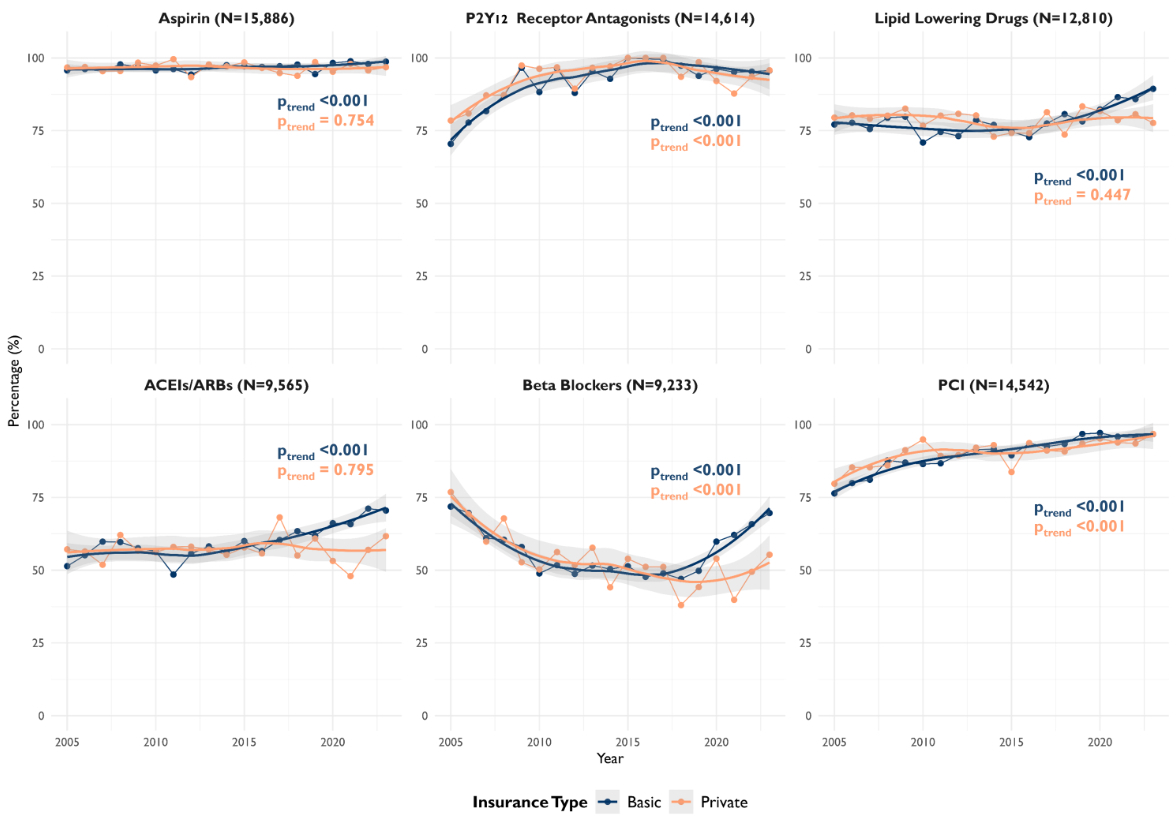
Figure 1Temporal
trends in the application of immediate individual guideline-recommended drugs
and PCI after ST-elevation myocardial infarction according to insurance type.
P-values were established by linear-by-linear association. Abbreviations: ACEI:
angiotensin-converting enzyme inhibitor; ARB: angiotensin II receptor blocker;
PCI: percutaneous coronary intervention.
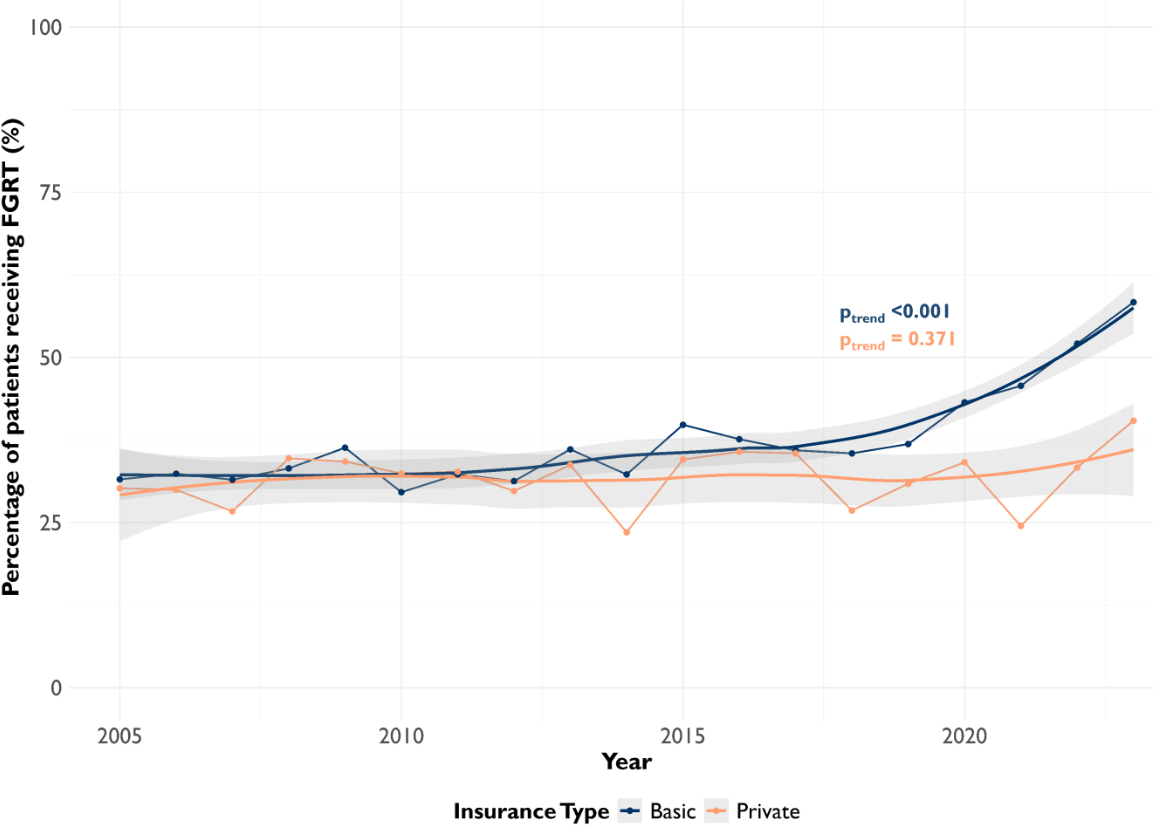
span class="image-label">Figure 2Temporal trends of immediate full
guideline-recommended treatment (optimal medical therapy plus percutaneous
coronary intervention) in ST-elevation myocardial infarction patients according
to insurance type. P-values were established by linear-by-linear association.
Abbreviations: FGRT: full guideline-recommended treatment.
Discussion
The main finding of this study is that we
observed no significant impact of health insurance status on the administration
of immediate optimal medical therapy or full guideline-recommended treatment, or
on in-hospital all-cause mortality, MACCE, length of hospital stay or 1-year
all-cause mortality after discharge of STEMI patients in Switzerland. These
findings suggest a high level of equity in acute cardiac care in the country.
Accordingly, while unadjusted analyses
suggested that patients with basic health insurance alone more often received
optimal medical therapy and full guideline-recommended treatment than patients
with additional supplementary private health insurance, after adjusting for
confounders in the multivariable analyses, no significant association between
insurance status and optimal medical therapy or full guideline-recommended
treatment was observed. This is in contrast to numerous previous publications,
which highlighted disparities in treatments among STEMI patients according to
insurance type across several countries [20–23]. In the USA, multiple studies
have reported that STEMI patients with supplementary private health insurance
were more likely to undergo PCI than those with other insurance plans [20–22].
One of these studies reported that patients with basic Medicaid insurance had
15% lower odds of receiving PCI than their propensity score-matched
counterparts with supplementary private health insurance [21]. Finally, two
American studies documented higher rates of coronary angiography [21] and CABG
[22] in STEMI patients with supplementary private health insurance compared to
other types of insurance. With respect to pharmacological treatment after
STEMI, one American study documented higher rates of aspirin and beta-blocker
prescription at discharge in coronary artery disease patients with
supplementary private health insurance compared to other insurance plans [24].
Similar findings from the same country were reported for the prescription of
aspirin, beta-blockers, heparin, clopidogrel and glycoprotein IIb/IIIa
inhibitors in a non-ST-elevation acute coronary syndrome population [25]. The
reasons for the discrepant findings observed in the current study are probably
multifactorial. Socioeconomic factors such as education and income are known to
affect in-hospital care [25–28]. As an example, due to financial concerns, less
wealthy patients may refuse to receive expensive guideline-recommended
treatments if they are not reimbursed by the insurance scheme [25]. In
Switzerland, socioeconomic disparities – with insurance status being a
reflection thereof – may be levelled out by existing premium subsidies for
people with low incomes. It also appears that in Switzerland the effect of
insurance type on cardiac treatment is context-dependent. Struja et al.
reported significantly higher rates of non-emergent cardiovascular procedures
including PCI in supplementary private health insurance patients who were
hospitalised for any medical reason, which may reflect the financial incentive
for physicians and hospitals to treat patients with supplementary private
health insurance [29]. Alternatively, it was also suggested that in Switzerland
supplementary private health insurance patients, who spend more on health
coverage, may attempt to receive medical care more intensively to maximise
their return [29]. We hypothesise, however, that these financially driven
aspects may not hold true in life-threatening conditions such as STEMI. On
another note, as shown in table 1, the crude prevalences of immediate optimal
medical therapy and full guideline-recommended treatment were rather low
(optimal medical therapy: 37.2%; full guideline-recommended treatment: 35.5%).
We hypothesise that these low numbers likely reflect the absence of uniform
guideline recommendations for all patients, particularly for the immediate
administration of beta-blockers and ACEIs/ARBs [17]. In contrast, optimal
medical therapy and full guideline-recommended treatment prevalences at
discharge were substantially higher, suggesting that in-hospital medical care
in Switzerland remains at a high standard. Overall, the lack of impact of
insurance status on in-hospital treatment suggests an excellent equity of
emergency cardiac care in Switzerland.
While the unadjusted in-hospital mortality
and MACCE rates were higher in the basic health insurance group than in
supplementary private health insurance patients, in the multivariable analyses,
the association was lost for both outcomes. In addition, there was no
significant association between insurance status and 1-year mortality after
discharge. These findings are in great contrast to previous analyses conducted
in various countries, which reported a significant effect of insurance status
on mortality [20, 21, 26]. One study from the USA observed a higher 30-day and
1-year mortality in AMI patients with public Medicaid insurance compared to
patients with private insurance [20]. Similar results for in-hospital mortality
were later described in a propensity score-matched STEMI cohort by Patel et
al., who reported 35% higher odds for Medicaid beneficiaries to die during the
hospitalisation compared to privately insured patients [21]. A more recent work
from Australia supported this notion, stating that AMI patients undergoing PCI
with private health insurance had 41% lower odds of dying in hospital than
those with public insurance plans [26]. Reportedly, the difference in mortality
was primarily influenced by STEMI patients and those living in major cities [26].
Apart from in-hospital treatment differences discussed above, a plethora of
potential reasons for differential in-hospital mortality according to insurance
status have been mentioned. Most notably, socioeconomic factors, access to
(PCI-capable) emergency department and greater delay to cardiac treatment have
been pointed out [3, 26, 30, 31]. While this study does not allow any
investigation of socioeconomic factors, access to and presentation in a Swiss
hospital with a catheterisation laboratory is, owing to the country’s small
geographic size, almost invariably guaranteed. Accordingly, in our study,
overall patient delay, i.e. the time elapsed from symptom onset to arrival at
hospital, was acceptable at 140 min and no difference between the groups. Somewhat
surprisingly, system delay, i.e. the time from arrival at the hospital to the
moment of PCI, was significantly shorter for patients with basic health
insurance. This is in contrast to the previous assumption that patients with
basic health insurance coverage have marginally longer system delays and may
also have contributed to the more balanced in-hospital mortality observed in
the present study [32].
Median length of hospital stay was not
impacted by insurance status. This result aligns with numerous studies that did
not identify insurance type as an independent predictor of the length of
hospital stay [21, 23, 26, 33].
In the present cohort, approximately 21% of
patients had supplementary private health insurance, a proportion consistent
with data from the Federal Office of Health, supporting the notion that the
study population mirrored the overall insurance status in Switzerland [7]. The
patient profile of individuals with basic health insurance and supplementary
private health insurance differed. In accordance with previous reports,
supplementary private health insurance patients appear to be older than those
with basic health insurance, emphasising the notion that younger generations
may be less willing to purchase supplementary private health insurance due to
the increasing financial burden [21, 26, 29]. Then, the proportion of
supplementary private health insurance was higher among women than among men in
this study. This finding does not necessarily correspond to previous works,
where sex distributions differed depending on the study [21, 26, 29]. In our
study, patients with basic health insurance exhibited higher rates of obesity,
smoking and diabetes than patients with supplementary private health insurance,
a finding in alignment with previous publications showing a greater prevalence
of cardiovascular risk factors in basic health insurance patients [8, 20, 21].
To our knowledge, although different
studies have investigated temporal trends on different drugs and PCI in the AMI
and STEMI setting, no studies have yet taken insurance status into account [34–36].
As expected, the analysis of temporal trends revealed a significant increase in
PCI procedures over time for both insurance groups, cementing its role as the most
important in-hospital intervention after STEMI. The administration of P2Y12
receptor blockers in both insurance types showed a significant increase from
the beginning of the study period, reaching its peak around the year 2017. In
the last few years, however, it appears that the rates of P2Y12
receptor blocker administration have been on a slight decline. This may be a
finding that needs to be investigated more thoroughly in the future. Figure 1
shows that for ACEIs/ARBs, beta-blockers and lipid-lowering drugs, disparities
between the two insurance types appear to have emerged in the last few years.
The reasons – especially the contribution of the recent COVID-19 pandemic – for
these disparities have yet to be established. It may be wise, however, to closely
monitor future trends for these medications.
Strengths and limitations
The study’s strengths lie in the large
patient sample covering the whole of Switzerland, the prospective nature of the
registry and the extended 18-year observation period. Additionally, the
comprehensive data collection enabled us to account for numerous potential
confounders.
The AMIS Plus registry has some weaknesses
inherent to all observational studies, especially those conducted over decades.
Participation and data entry by hospitals in the registry is voluntary and the
number of participating hospitals at specific times may fluctuate. In addition,
the potential impact of unmeasured or unknown confounders, especially
socioeconomic factors including education or income, cannot be ruled out [30,
31, 37, 38]. Also, there may be complex factors including specific treatment
decisions such as delayed treatment that may have influenced certain covariates
or outcomes of interest. We also acknowledge that excluding transferred
patients and those with in-hospital symptom onset may have influenced the
composition of the study cohort and the outcomes assessed. Regarding the
administration of the analysed drugs, we are reliant on the information
provided by the hospitals and have no data on dosage or contraindications which
may have impacted optimal medical therapy or full guideline-recommended
treatment. Regarding 1-year mortality, there are no data on post-discharge
therapy and health, which may have influenced this outcome.
Conclusion
This study provides evidence that, in
Switzerland, insurance status does not influence in-hospital treatment or
outcomes in STEMI patients, including guideline-recommended therapies, or in-hospital
and 1-year mortality. This suggests that Swiss hospitals maintain a high level
of equity in emergency cardiac care.
Data availability
Individual data used for the construction of the AMIS Plus
registry are the property of the hospitals participating in the AMIS Plus
registry and may only be made available by each hospital’s Principal
Investigator and the AMIS Plus Steering Committee. Due to data protection
regulations related to the different hospitals involved in this study, the
authors do not have authorisation to provide unrestricted data access. However,
analysis files may be provided to other researchers subject to approval by the
AMIS Plus Steering Committee and subsequent negotiation of an individual AMIS
Plus module contract with the AMIS Plus Steering Committee. Requests must be
submitted to Prof. Dr Hans Rickli, President of the AMIS Plus Steering
Committee (hans.rickli[at]kssg.ch) and Dr Dragana
Radovanovic, Head of the AMIS Plus Data Centre (dragana.radovanovic[at]uzh.ch).
Acknowledgments
We thank Ms Jenny Piket for the English revision and
professional proofreading of the manuscript. AMIS Plus Participants 2005–2023. The
authors would like to express their gratitude to the teams of the following
hospitals (listed in alphabetical order with the names of the local principal
investigators): Aarau, Kantonsspital (P Lessing); Affoltern am Albis, Spital (F
Hess); Altdorf, Kantonsspital Uri (R Simon/S Gisler); Altstätten, Spital (PJ
Hangartner); Baden, Kantonsspital (U Hufschmid); Basel, St. Claraspital (L
Altwegg); Basel, Universitätsspital (R Jeger); Bern, Beau-Site Klinik (S
Trummler); Bern, Inselspital (S Windecker); Bern, Tiefenauspital (P Loretan);
Biel, Spitalzentrum (C Roethlisberger); Bülach, Spital (G Mang); Burgdorf,
Regionalspital Emmental (D Ryser); Davos, Spital (W Kistler); Dornach, Spital
(A Droll); Einsiedeln, Regionalspital (S Stäuble); Flawil, Spital (G Freiwald);
Frauenfeld Kantonsspital (HP Schmid); Fribourg, Hôpital cantonal (JC Stauffer/S
Cook); Frutigen, Spital (K Bietenhard); Genève, Hôpitaux universitaires (M
Roffi); Grenchen, Spital (R Schönenberger); Herisau, Kantonales Spital (M
Bötschi); Horgen, See Spital (B Federspiel); Interlaken, Spital (EM Weiss);
Kreuzlingen, Herzzentrum Bodensee (K Weber); La Chaux-de-Fonds, Hôpital (H
Zender); Lachen, Regionalspital (I Poepping); Langnau im Emmental,
Regionalspital (A Hugi); Laufenburg, Gesundheitszentrum Fricktal (E Koltai);
Lausanne, Centre hospitalier universitaire vaudois (JF Iglesias/S Fournier);
Lugano, Cardiocentro Ticino (G Pedrazzini); Luzern, Luzerner Kantonsspital (P
Erne/F Cuculi); Männedorf, Kreisspital (T Heimes); Mendrisio, Ospedale
regionale (A Pagnamenta); Meyrin, Hôpital de la Tour (P Urban/A Fassa);
Moutier, Hôpital du Jura bernois (C Stettler); Münsingen, Spital (F Repond);
Münsterlingen, Kantonsspital (F Widmer); Muri, Kreisspital für das Freiamt (C
Heimgartner); Nyon, Group. Hosp. Ouest lémanique (R Polikar); Olten,
Kantonsspital (S Bassetti/ S Ernst); Rheinfelden, Gesundheitszentrum Fricktal
(HU Iselin); Rorschach, Spital (M Giger); Samedan, Spital Oberengadin (P Egger);
Sarnen, Kantonsspital Obwalden (T Kaeslin); Schaffhausen, Kantonsspital (A
Fischer); Schlieren, Spital Limmattal (T Herren); Scuol, Ospidal d'Engiadina
Bassa (C Neumeier/G Flury); Sion, Hôpital du Valais (G Girod); Solothurn,
Bürgerspital (R Vogel); Stans, Kantonsspital Nidwalden (B Niggli); St Gallen,
Kantonsspital (H Rickli); Sursee, Luzerner Kantonsspital (J Nossen); Thun,
Spital (U Stoller); Uster, Spital (E Bächli/J Debrunner); Walenstadt,
Kantonales Spital (D Schmidt/J Hellermann); Wetzikon, GZO Spital (U Eriksson);
Winterthur, Kantonsspital (T Fischer); Wolhusen, Luzerner Kantonsspital (M
Peter/Y Suter); Zofingen, Spital (S Gasser); Zollikerberg, Spital (R Fatio);
Zürich, Hirslanden Klinik (C Wyss); Zürich, Hirslanden Klinik im Park (O
Bertel); Zürich, Universitätsspital, Intensivmedizin (M Maggiorini); Zürich,
Universitätsspital, Kardiologie (B Stähli); Zürich, Stadtspital Triemli (F
Eberli); Zürich, Stadtspital Waid (S Christen).
Jan
Loosli, MSc
AMIS
Plus Data Center
Epidemiology,
Biostatistics and Prevention Institute
University
of Zurich
Hirschengraben 84
CH-8001 Zurich
jan.loosli[at]amis-plus.ch
References
1. Mensah GA, Wei GS, Sorlie PD, Fine LJ, Rosenberg Y, Kaufmann PG, et al. Decline in
Cardiovascular Mortality: Possible Causes and Implications. Circ Res. 2017 Jan;120(2):366–80.
10.1161/CIRCRESAHA.116.309115
2. Laforgia PL, Auguadro C, Bronzato S, Durante A. The Reduction of Mortality in Acute
Myocardial Infarction: From Bed Rest to Future Directions. Int J Prev Med. Iran; 2022;13:56.
https://doi.org/10.4103/ijpvm.IJPVM_122_20
3. Biswas S, Andrianopoulos N, Duffy SJ, Lefkovits J, Brennan A, Walton A, et al. Impact
of Socioeconomic Status on Clinical Outcomes in Patients With ST-Segment-Elevation
Myocardial Infarction. Circ Cardiovasc Qual Outcomes. United States; 2019;12:e004979.
https://doi.org/10.1161/CIRCOUTCOMES.118.004979
4. Barreto J, Matos LC, Quinaglia JC, Sposito AC, Carvalho LS. The impact of low income
on long-term mortality of myocardial infarction patients: results from the Brazilian
Heart Study. Curr Med Res Opin. 2021 Oct;37(10):1689–95. 10.1080/03007995.2021.1965561
5. Biller-Andorno N, Zeltner T. Individual Responsibility and Community Solidarity —
The Swiss Health Care System. New England Journal of Medicine. Massachusetts Medical
Society; 2024;373:2193–7. https://doi.org/10.1056/NEJMp1508256
6. Kalouguina V, Wagner J. How do health, care services consumption and lifestyle factors
affect the choice of health insurance plans in switzerland? Risks. MDPI AG. 2020;8(2):41.
10.3390/risks8020041
7. Bundesamt für Gesundheit. Statistiken zur Krankenversicherung [Internet]. BAG; 2022 Mar. https://www.bag.admin.ch
8. Roth S, Zufferey J, Pellegrini S. Personen mit und ohne Spitalzusatzversicherung.
Vergleich der soziodemografischen Merkmale, des Gesundheitszustands und der Inanspruchnahme
von Versorgungsleistungen. BFS; 2021. pp. 1–8.
9. Radovanovic D, Erne P. AMIS Plus: swiss registry of acute coronary syndrome. Heart.
2010 Jun;96(12):917–21. 10.1136/hrt.2009.192302
10. Charlson ME, Pompei P, Ales KL, MacKenzie CR. A new method of classifying prognostic
comorbidity in longitudinal studies: development and validation. J Chronic Dis. 1987;40(5):373–83.
10.1016/0021-9681(87)90171-8
11. Radovanovic D, Seifert B, Urban P, Eberli FR, Rickli H, Bertel O, et al.; AMIS Plus
Investigators. Validity of Charlson Comorbidity Index in patients hospitalised with
acute coronary syndrome. Insights from the nationwide AMIS Plus registry 2002-2012.
Heart. 2014 Feb;100(4):288–94. 10.1136/heartjnl-2013-304588
12. Killip T 3rd, Kimball JT. Treatment of myocardial infarction in a coronary care unit.
A two year experience with 250 patients. Am J Cardiol. United States; 1967;20:457–64.
https://doi.org/10.1016/0002-9149(67)90023-9
13. Amsterdam EA, Wenger NK, Brindis RG, Casey DE Jr, Ganiats TG, Holmes DR Jr, et al. 2014
AHA/ACC Guideline for the Management of Patients with Non-ST-Elevation Acute Coronary
Syndromes: a report of the American College of Cardiology/American Heart Association
Task Force on Practice Guidelines. J Am Coll Cardiol. 2014 Dec;64(24):e139–228. 10.1016/j.jacc.2014.09.017
14. Piepoli MF, Hoes AW, Agewall S, Albus C, Brotons C, Catapano AL, et al.; ESC Scientific
Document Group. 2016 European Guidelines on cardiovascular disease prevention in clinical
practice: The Sixth Joint Task Force of the European Society of Cardiology and Other
Societies on Cardiovascular Disease Prevention in Clinical Practice (constituted by
representatives of 10 societies and by invited experts)Developed with the special
contribution of the European Association for Cardiovascular Prevention & Rehabilitation
(EACPR). Eur Heart J. 2016 Aug;37(29):2315–81. 10.1093/eurheartj/ehw106
15. Fox AN, Skrepnek GH, Miller JL, Schwier NC, Ripley TL. Optimal Medical Therapy Prescribing
Patterns and Disparities Identified in Patients with Acute Coronary Syndromes at an
Academic Medical Center in an Area with High Coronary Heart Disease-Related Mortality.
Am J Cardiovasc Drugs. 2019 Apr;19(2):185–93. 10.1007/s40256-018-0308-x
16. Wongsalap Y, Kengkla K, Poolpun D, Saokaew S. Trends in optimal medical therapy at
discharge and clinical outcomes in patients with acute coronary syndrome in Thailand.
J Cardiol. 2021 Jun;77(6):669–76. 10.1016/j.jjcc.2020.12.015
17. Byrne RA, Rossello X, Coughlan JJ, Barbato E, Berry C, Chieffo A, et al.; ESC Scientific
Document Group. 2023 ESC Guidelines for the management of acute coronary syndromes.
Eur Heart J. 2023 Oct;44(38):3720–826. 10.1093/eurheartj/ehad191
18. Ioannidis JP. The Proposal to Lower P Value Thresholds to. 005. JAMA. 2018 Apr;319(14):1429–30.
10.1001/jama.2018.1536
19. Benjamin DJ, Berger JO, Johannesson M, Nosek BA, Wagenmakers EJ, Berk R, et al. Redefine
statistical significance. Nat Hum Behav. 2018 Jan;2(1):6–10. 10.1038/s41562-017-0189-z
20. Niedzwiecki MJ, Hsia RY, Shen YC; Journal of the American Heart Association. Not all
insurance is equal: differential treatment and health outcomes by insurance coverage
among nonelderly adult patients with heart attack. J Am Heart Assoc. 2018 Jun;7(11):e008152.
10.1161/JAHA.117.008152
21. Patel N, Gupta A, Doshi R, Kalra R, Bajaj NS, Arora G, et al. In-Hospital Management
and Outcomes After ST-Segment-Elevation Myocardial Infarction in Medicaid Beneficiaries
Compared With Privately Insured Individuals. Circ Cardiovasc Qual Outcomes. 2019 Jan;12(1):e004971.
10.1161/CIRCOUTCOMES.118.004971
22. Hiestand BC, Prall DM, Lindsell CJ, Hoekstra JW, Pollack CV, Hollander JE, et al. Insurance
status and the treatment of myocardial infarction at academic centers. Acad Emerg
Med. 2004 Apr;11(4):343–8. 10.1197/j.aem.2003.12.017
23. Gupta R, Makkar JS, Sharma SK, Agarwal A, Sharma KK, Bana A, et al. Association of
health insurance status with coronary risk factors, coronary artery disease, interventions
and outcomes in India. Int J Cardiol Cardiovasc Risk Prev. 2022 Aug;14:200146. 10.1016/j.ijcrp.2022.200146
24. Vidovich MI, Vasaiwala S, Cannon CP, Peterson ED, Dai D, Hernandez AF, et al.; Get
With Guidelines Steering Committee and Investigators. Association of insurance status
with inpatient treatment for coronary artery disease: findings from the Get With the
Guidelines program. Am Heart J. 2010 Jun;159(6):1026–36. 10.1016/j.ahj.2010.03.013
25. Calvin JE, Roe MT, Chen AY, Mehta RH, Brogan GX, Delong ER, et al. Insurance Coverage
and Care of Patients with Non-ST-Segment Elevation Acute Coronary Syndromes [Internet].
2006. https://annals.org
26. de Oliveira Costa J, Pearson SA, Brieger D, Lujic S, Shawon MS, Jorm LR, et al. In-hospital
outcomes by insurance type among patients undergoing percutaneous coronary interventions
for acute myocardial infarction in New South Wales public hospitals. Int J Equity
Health. 2023 Oct;22(1):226. 10.1186/s12939-023-02030-1
27. Philbin EF, McCullough PA, DiSalvo TG, Dec GW, Jenkins PL, Weaver WD. Socioeconomic
Status Is an Important Determinant of the Use of Invasive Procedures After Acute Myocardial
Infarction in New York State. Circulation. Circulation. 2000;102 suppl_3:Iii–107.
10.1161/circ.102.suppl_3.III-107
28. Shen JJ, Wan TT, Perlin JB. An exploration of the complex relationship of socioecologic
factors in the treatment and outcomes of acute myocardial infarction in disadvantaged
populations. Health Serv Res. 2001 Aug;36(4):711–32.
29. Struja T, Suter F, Rohrmann S, Koch D, Mueller B, Schuetz P, et al. Comparison of
Cardiovascular Procedure Rates in Patients With Supplementary vs Basic Insurance in
Switzerland. JAMA Netw Open. 2023 Jan;6(1):e2251965. 10.1001/jamanetworkopen.2022.51965
30. Levine GN, Bates ER, Blankenship JC, Bailey SR, Bittl JA, Cercek B, et al. 2011 ACCF/AHA/SCAI
Guideline for Percutaneous Coronary Intervention: executive summary: a report of the
amierican college of cardiology foundation/American heart association task force on
practice guidelines and the society for cardiovascular angiography and interventions.
Circulation. Circulation. 2011;124(23):e574–651. 10.1161/CIR.0b013e31823ba622
31. Foraker RE, Rose KM, Mcginn AP. Chirayath; Suchindran M, David; et al. Neighborhood
Income, Health Insurance, and Prehospital Delay for Myocardial Infarction The Atherosclerosis
Risk in Communities Study [Internet]. 2008. www.jamaarchivescme.com
32. Herring A, Alter HJ, Woolhandler S, Himmelstein D. THE EFFECT OF INSURANCE STATUS
ON TIME TO PCI FOR PATIENTS WITH STEMI: FINDINGS FROM THE CATHPCI REGISTRY. J Am Coll
Cardiol. 2013;61(10):E95. 10.1016/S0735-1097(13)60096-0
33. Kreindel S, Rosetti R, Goldberg R, Savageau J, Yarzebski J, Gore J, et al. Health
Insurance Coverage and Outcome Following Acute Myocardial Infarction A Community-wide
Perspective. 1997.
34. Smedegaard L, Charlot MG, Gislason GH, Hansen PR. Temporal trends in acute myocardial
infarction presentation and association with use of cardioprotective drugs: a nationwide
registry-based study. Eur Heart J Cardiovasc Pharmacother. 2018 Apr;4(2):93–101. 10.1093/ehjcvp/pvx016
35. Gao Y, Masoudi FA, Hu S, Li J, Zhang H, Li X, et al. Trends in Early Aspirin Use Among
Patients With Acute Myocardial Infarction in China, 2001–2011: The China PEACE‐Retrospective
AMI Study. Journal of the American Heart Association. Wiley; 3:e001250. https://doi.org/10.1161/JAHA.114.001250
36. Shah RU, Henry TD, Rutten-Ramos S, Garberich RF, Tighiouart M, Bairey Merz CN. Increasing
percutaneous coronary interventions for ST-segment elevation myocardial infarction
in the United States: progress and opportunity. JACC Cardiovasc Interv. 2015 Jan;8(1 1
Pt B):139–46. 10.1016/j.jcin.2014.07.017
37. Philbin EF, McCullough PA, DiSalvo TG, Dec GW, Jenkins PL, Weaver WD. Socioeconomic
Status Is an Important Determinant of the Use of Invasive Procedures After Acute Myocardial
Infarction in New York State. Circulation. Circulation. 2000;102 suppl_3:Iii–107.
10.1161/circ.102.suppl_3.III-107
38. Spycher J, Morisod K, Eggli Y, Moschetti K, Le Pogam MA, Peytremann-Bridevaux I, et
al. Indicators on Healthcare Equity in Switzerland. New Evidence and Challenges. Report
commissioned by the Federal Office of Public Health. Bern: FOPH; 2021.
Appendix
Table S1Results from multivariable logistic mixed effects regression analyses for OMT and
FGRT at discharge (n = 8,462).
| Characteristic |
Optimal medical therapy |
Full guideline-recommended treatment |
| OR |
95% CI |
p-value |
OR |
95% CI |
p-value |
| (Intercept) |
2.18 |
1.41, 3.37 |
<0.001 |
2.04 |
1.32, 3.13 |
0.001 |
| Insurance type
(basic) |
1.03 |
0.91, 1.17 |
0.68 |
1.00 |
0.88, 1.13 |
>0.99 |
| Age (years) |
0.99 |
0.99, 1.0 |
<0.001 |
0.99 |
0.99, 1.0 |
<0.001 |
| Male
sex |
1.17 |
1.03, 1.31 |
0.012 |
1.17 |
1.04, 1.31 |
0.010 |
| BMI >30 (obesity) |
1.14 |
1.00, 1.29 |
0.052 |
1.14 |
1.01, 1.30 |
0.040 |
| Killip classes >2 |
1.04 |
0.83, 1.32 |
0.73 |
1.01 |
0.80, 1.27 |
0.93 |
| Impaired LVEF |
1.10 |
0.90, 1.36 |
0.35 |
1.05 |
0.86, 1.29 |
0.61 |
| Multivessel disease |
1.16 |
1.05, 1.29 |
0.005 |
1.15 |
1.04, 1.27 |
0.008 |
| Previous AMI |
0.86 |
0.74, 1.01 |
0.065 |
0.86 |
0.74, 1.00 |
0.051 |
| Diabetes |
1.07 |
0.92, 1.25 |
0.38 |
1.01 |
0.87, 1.17 |
0.93 |
| Cancer |
0.76 |
0.60, 0.96 |
0.022 |
0.76 |
0.60, 0.96 |
0.021 |
| Current smoker |
0.85 |
0.76, 0.95 |
0.004 |
0.87 |
0.78, 0.97 |
0.013 |
| Dyslipidemia |
1.02 |
0.92, 1.14 |
0.68 |
1.05 |
0.94, 1.17 |
0.43 |
| Arterial hypertension |
1.48 |
1.32, 1.65 |
<0.001 |
1.42 |
1.27, 1.58 |
<0.001 |
| Maximum CK (max. level during hospitalisation, lU/l) |
1.00 |
1.00, 1.00 |
<0.001 |
1.00 |
1.00, 1.00 |
<0.001 |
| Glycemia (on admission, mmol/l) |
1.01 |
0.99, 1.02 |
0.47 |
1.01 |
0.99, 1.02 |
0.32 |