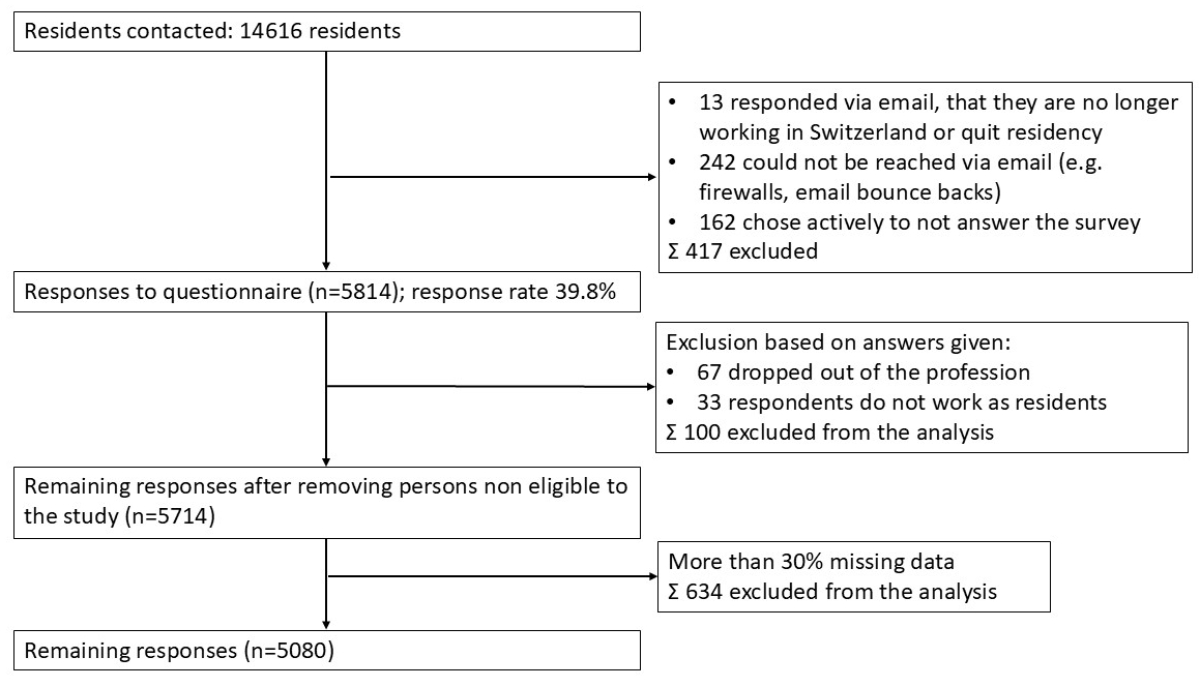
Figure 1Flowchart of participants.
DOI: https://doi.org/https://doi.org/10.57187/4549
In common with many other countries, Switzerland is facing a critical physician shortage within the next 10 to 15 years [1, 2]: Switzerland currently lacks around 5000 doctors and, overall, 10.0% of doctors quit the profession before retirement [3, 4]. Recent estimates show that the biggest medical workforce, general practitioners, will dramatically decrease by 44.0% within 10 years [5]. This predicted shortage can be explained by the fact that the average age of practitioners is 50 years and by the retirement of the baby-boomer generation (one-quarter of doctors is aged 60 years or over) [1, 2, 6].
Additionally, in a survey carried out among medical students in 2023, 34.0% of respondents reconsidered their career choice of working as a doctor, further exacerbating the issue [7]. Conversely, the growing demand for healthcare and physicians is driven by changes in sociodemographic structures [8]. This is not a new issue as a national cohort study from 2019 showed that 14.0% of physicians who graduated in Switzerland between 1980 and 2009 have left patient care [9]. This study was not able to determine sex or language region as attrition factors, but the intention to leave was higher among physicians who had graduated more recently [9]. A study by the Swiss Medical Association (FMH) showed that, overall, 10.0% of all doctors leave direct patient care [4, 10]. They showed that most of the doctors who leave clinical work do so before finishing residency and that the majority continue in a related field requiring medical knowledge [4, 10]. Only 9.0% of doctors who had left the profession reported considering returning to clinical work [4, 10]. Attrition factors refer to the variables that increase the likelihood of individuals leaving a profession or workplace [11], whereas retention factors encompass those elements that promote continued engagement and reduce turnover, thereby supporting workforce stability and sustainability. For the present study, we use the term attrition factors to describe aspects associated with thoughts about leaving, although we did not survey residents who had actually left. Even though intention to leave among physicians is lower in Switzerland than in other European countries [10, 12], the trend is alarming. A survey done among internal medicine residents (n = 472) in 2018 reported that 21.0% would rather not or would not at all want to become physicians again and 43.0% wished to leave clinical practice at least sometimes [13]. In 2024, a survey done among 1324 hospital physicians showed that 23% of the residents who answered were thinking about quitting the Swiss healthcare system [14]. Again, in 2024, a survey done among emergency physicians showed that 40.6% of respondents reported considering a change in their career at least once a month [15]. Residents are legally allowed to work 50 hours per week in Switzerland [16].
Hence, in the present cross-sectional study, our aim was to identify the percentage of residents who consider leaving their job and/or the medical profession and the sociodemographic and profession-related (i.e. attrition-related) factors associated with these considerations.
The primary outcome was the percentage of residents considering leaving the job or the profession. The secondary outcome was the sociodemographic and profession-related factors influencing residents’ consideration to leave the job or the profession.
This cross-sectional study does not fall under the Swiss Human Research Act; hence no ethical approval was needed. Even so, data was collected anonymously. We sought informed consent from all participants at the start of the survey and they were free to choose not to participate. Data was processed and stored according to Swiss data protection laws. The present manuscript adheres to the consensus-based checklist for the reporting of survey studies (CROSS) [17]. We did not publish or register the study protocol.
This cross-sectional study aimed to investigate the sociodemographic and profession-related factors influencing intention to leave among residents in Switzerland. It was conducted by the Swiss Institute of Medical Education (SIWF/ISFM), the national organisation responsible for regulating and overseeing postgraduate medical education and continuing professional development in Switzerland. The questionnaire (supplement 1 in the appendix) was developed as part of the doctoral studies of the first author. It was created using existing questions from similar studies [7, 10, 14, 18], the yearly evaluation of resident training sites [19] and the member survey of vsao/asmac (Swiss Association of Junior Doctors and Consultants) [20]. The questionnaire was designed as an online study and answered on a voluntary basis without incentives offered. The questionnaire comprised 40 items, of which 17 multiple-choice questions were analysed for this study. Notably, 3 of these questions were designated as mandatory (whether residents currently work as residents and their intention to leave the job and/or profession). For the question on the frequency of thoughts about leaving the job or profession, participants could select “daily”, “weekly”, “monthly” or “never”. A pilot phase among ten peer residents assessed the survey’s feasibility, length and comprehensibility. The questionnaire was designed in German and translated into French and Italian by professional translators and subsequently tested with 3–5 individuals for each language. Residents could choose their preferred language. The English translation was done for the scientific publication. For technical reasons, the first roll-out included a pilot group of 500 residents, who were later included in the analysis. The survey aimed to include all residents completing postgraduate medical education in Switzerland. To ensure eligibility, the survey included screening questions so that only residents currently working in Switzerland could participate. Exclusions due to missing data are shown in figure 1. Residents were invited to participate via a personalised link to the online survey sent to their registered e-Logbook email address using SoSci Survey [21], a standardised online survey tool. The e-Logbook, hosted by SIWF, is an online database used by all residents to document their postgraduate medical training and is a mandatory documentation instrument when applying for the specialist title. The collection period for the pilot phase ran from 17 to 25 October 2024 and the main phase of data collection ran from 4 to 24 November 2024. The responses from the pilot group were included in the overall data collection. Two reminders were sent in both phases to encourage participation. Additionally, vsao/asmac invited members to participate via a survey link in their newsletter and issued a reminder through social media. We did not implement a technical mechanism to prevent multiple submissions.
To facilitate comparison of the groups, the outcome variables were dichotomised into “no intention to leave” versus “intention to leave”, with the latter encompassing “daily”, “weekly” and “monthly” responses. For continuous variables, the mean and standard deviation are reported, whereas the count and percentage are given for ordinal and nominal variables. The inclusion criterion was residents reachable via their logbook or the vsao newsletter. Exclusion criteria were residents not working in Switzerland, those no longer engaged in a residency programme and those no longer engaged as residents in direct patient care. Rows with more than 30% missing data were excluded entirely [22]. Classification reliability irretrievably depends on the proportion of missing data; valid results are reported when less than 30.0% of data is missing. Since the main goal was to classify participants reliably as either intending to leave or not, this margin was applied a priori. In addition to the quantity of missing data, the quality was evaluated using Little’s Missing Completely at Random (MCAR) test. If the data was not MCAR, no listwise deletion or imputation method was applied. All participants were included in the statistical analysis regardless of whether data for the primary outcome was available. This approach was intended to avoid introducing systematic differences between groups [23] and to enhance the generalisability of the findings [23]. Restricting analyses to participants with available primary outcome data could have inflated the response to our primary outcome [24]. The Welch test was used as the standard test, as has been recommended without requiring assessment of the normality assumption [25–28]. Multinominal logistic regression models were applied to identify factors associated with the intention to leave the job or the profession. Statistical significance was set at p <0.05. All analyses were performed using R studio version 2024.4.02 [29]. The following packages were used: Read Excel Files (readxl 1.4.5), R Commander (Rcmdr 2.9-5), Miscellaneous Function T. Yanagida (misty 0.7.0), Various R Programming Tools for Model Fitting (gmodels 2.19.1), Companion to Applied Regression (car 3.1-3), A dplyr Back End for Databases (dplyr 2.5.0) and Epidemiology Tools (epitools 0.5-10.1).
From the 500 residents selected for the pilot phase, 23.8% (n = 119) responded. Combined with the main data collection phase, a total of 14,616 residents were contacted. Overall, 5814 responses were obtained, corresponding to a 39.7% response rate. After excluding non-eligible cases, 5080 (87.4%) cases remained (figure 1), all of whom provided informed consent. Data was not MCAR (p <0.001); therefore, no imputation method was applied.
Figure 1Flowchart of participants.
A total of 5080 participants were included in the analysis (supplement 2 in the appendix). The majority were born between 1991 and 1995 and identified with the female gender. Participants were aged 32 ± 4.1 years on average. Most participants (55.4%) obtained their medical degree in Switzerland, followed by Germany (17.8%). The great majority worked in a German-speaking region (76.5%) and reported at least one parent being a physician (78.6%). Most participants (92.0%) were employed as residents, had already chosen a specialty (96.8%) and were working in a specialty-specific postgraduate training year (73.0%). A total of 2967 participants (58.4%) reported an employment contract with 50 working hours per week, which corresponds to full-time employment in Switzerland. The majority reported satisfaction with their current workplace (83.9%), while 51.6% emphasised the importance of teaching during working hours.
Regarding our primary outcome variable (intention to leave), 45.6% (n = 2321) of residents said that they thought about leaving their current job, with varying frequency, while 55.1% (n = 2800) were considering leaving the medical profession.
Residents in our cohort had been working an average of 42.0 ± 25.7 months. A significant difference in intention to leave the job, but not the profession, was found among those with longer work experience. The mean effective weekly working time was 51.1 ± 9.8 hours, exceeding contractual hours by 4.7 ± 6.8 hours. The majority of residents (53.1%) indicated that they worked more than 50 hours a week. Longer effective weekly working hours were in particular associated with a higher intention to leave for both the job (OR: 2.6) and the profession (OR: 1.7). Similarly, a greater discrepancy between contractual and effective weekly working hours predicted higher intention to leave. Neither mean employment rate nor contractual weekly working hours showed a significant association with intention to leave (tables 1 and 2).
Table 1Characteristics of the sample for the frequency of thoughts about leaving the current job or the medical profession
| Characteristic | Leaving job, n = 5080 | Leaving profession, n = 5080 | |||||
| No: n = 2127 | Yes: n = 2321 | Missing: n = 632 | No: n = 1924 | Yes: n = 2800 | Missing: n = 356 | ||
| n (%) | n (%) | n (%) | [n (%)] | n (%) | n (%) | ||
| Year of birth (corresponding age) (n = 3632) | 1996–2000 (24–28 years) | 312 (21.0%) | 284 (17.0%) | 79 (16.0%) | 263 (20.0%) | 361 (18.0%) | 51 (17.0%) |
| 1991–1995 (29–33 years) | 773 (51.0%) | 897 (54.0%) | 190 (40.0%) | 648 (49.0%) | 1088 (54.0%) | 124 (42.0%) | |
| 1986–1990 (34–38 years) | 302 (20.0%) | 328 (20.0%) | 126 (26.0%) | 271 (20.0%) | 408 (20.0%) | 77 (26.0%) | |
| <1985 (39 years or over) | 117 (7.8%) | 139 (8.4%) | 85 (18.0%) | 151 (11.0%) | 150 (7.5%) | 40 (14.0%) | |
| Gender (n = 5028) | Male [n (%)] | 842 (40.0%) | 897 (39%) | 221 (36.0%) | 752 (39.0%) | 1073 (39.0%) | 135 (39.0%) |
| Female | 1268 (60.0%) | 1404 (61.0%) | 396 (64.0%) | 1156 (61.0%) | 1699 (61.0%) | 213 (61.0%) | |
| Country of degree (n = 5038) | Switzerland | 1198 (57.0%) | 1291 (56.0%) | 326 (52.0%) | 985 (52.0%) | 1655 (60.0%) | 175 (49.0%) |
| Foreign | 920 (43.0%) | 1008 (44.0%) | 295 (48.0%) | 926 (48.0%) | 1118 (40.0%) | 179 (51.0%) | |
| Language region (n = 5080) | French | 350 (16.0%) | 410 (18.0%) | 145 (23.0%) | 387 (20.0%) | 431 (15.0%) | 87 (24.0%) |
| German | 1630 (77.0%) | 1798 (77.0%) | 458 (72.0%) | 1388 (72.0%) | 2244 (80.0%) | 254 (71.0%) | |
| Italian | 147 (6.9%) | 113 (4.9%) | 29 (4.6%) | 149 (7.7%) | 125 (4.5%) | 15 (4.2%) | |
| At least one parent who is a physician (n = 5064) | No | 462 (22.0%) | 481 (21.0%) | 127 (20.0%) | 433 (23.0%) | 557 (20.0%) | 80 (22.0%) |
| Yes | 1662 (78.0%) | 1831 (79.0%) | 501 (80.0%) | 1489 (77.0%) | 2229 (80.0%) | 276 (78.0%) | |
| Working as a resident (n = 5053) | Yes | 2120 (100.0%) | 2302 (100.0%) | 256 (41.0%) | 1820 (95.0%) | 2559 (92.0%) | 299 (85.0%) |
| No | 96 (5.0%) | 225 (8.1%) | 54 (15.0%) | ||||
| Decided on specialisation (n = 4991) | Yes | 2097 (99.0%) | 2264 (99.0%) | 555 (95.0%) | 1891 (99.0%) | 2701 (98.0%) | 324 (97.0%) |
| No | 16 (0.8%) | 32 (1.4%) | 27 (4.6%) | 11 (0.6%) | 53 (1.9%) | 11 (3.3%) | |
| In specialist-specific year (n = 4511) | Yes | 1704 (83.0%) | 1818 (82.0%) | 184 (81.0%) | 1468 (83.0%) | 2006 (81.0%) | 232 (88.0%) |
| No | 357 (17.0%) | 406 (18.0%) | 42 (19.0%) | 303 (17.0%) | 470 (19.0%) | 32 (12.0%) | |
| Satisfied with current job (n = 4128) | Yes, more or less yes | 1894 (99.0%) | 1432 (70.0%) | 137 (88.0%) | 1519 (92.0%) | 1776 (78.0%) | 168 (86.0%) |
| No, not really | 19 (1.0%) | 628 (30.0%) | 18 (12.0%) | 129 (7.8%) | 509 (22.0%) | 27 (14.0%) | |
| Is teaching during working hours important? (n = 4574) | Yes, more or less yes | 1439 (68.0%) | 833 (36.0%) | 86 (50.0%) | 1128 (62.0%) | 1117 (44.0%) | 113 (53.0%) |
| No, not really | 665 (32.0%) | 1466 (64.0%) | 85 (50.0%) | 681 (38.0%) | 1436 (56.0%) | 99 (47.0%) | |
Table 2Effect of workload on frequency of thoughts about leaving the current job or the medical profession.
| Characteristic | All | Leaving job | p | Leaving profession | p |
| Mean ± SD | Mean ± SD | Mean ± SD | |||
| Experience as a resident in months | 42.0 ± 25.7 | 42.8 ± 25.1 | <0.05 | 41.9 ± 25.1 | 0.90 |
| Employment rate in % | 93.7 ± 13.6 | 93.6 ± 12.8 | 0.99 | 93.5 ± 13.1 | 0.20 |
| Effective weekly working hours | 51.1 ± 9.8 | 52.8 ± 9.84 | <0.001 | 52.1 ± 13.3 | <0.001 |
| Contractual weekly working hours | 46.4 ± 6.6 | 46.5 ± 6.4 | 0.26 | 46.4 ± 6.5 | 0.67 |
| Difference (effective – contractual) | 4.7 ± 6.8 | 6.1 ± 7.0 | <0.001 | 5.4 ± 6.5 | <0.001 |
In table 3, the univariate and multivariate analyses of intention to leave the job showed overall consistency, with some attenuation of effects in adjusted models. Having at least one physician parent showed no association with intention to leave in either analysis. The same is true for the highest education of either parent (supplement A). Italian-speaking residents demonstrated significantly lower intention to leave in both models, with odds ratios decreasing from 0.66 in the univariate to 0.51 in the multivariate model, reinforcing the robustness of this protective effect. Dissatisfaction with the training site emerged as the strongest predictor, with extremely high odds in the univariate analysis (OR: 43.7) that, although reduced in the multivariate model (OR: 31.2), remained very large and statistically significant. A similar pattern was observed for dissatisfaction with teaching during working hours, where odds decreased from 3.81 to 2.55 after adjustment yet remained strongly associated with higher intention to leave. Being undecided about the specialist title showed a modest association in the univariate model (OR: 1.85, p = 0.045) that lost significance after adjustment, suggesting confounding. Regarding age, the youngest group (2000–1996) showed consistently lower intention to leave in both models (OR: 0.78 and 0.74), whereas no significant associations were observed in other age groups. Country of degree (Swiss vs foreign) had no effect in either model. Overall, the multivariate analysis confirmed the major findings of the univariate models, particularly the strong influence of training site satisfaction and perceived importance of teaching, while attenuating weaker associations such as specialist title decision.
Table 3Regression analysis with the outcome: frequency of thoughts about leaving the job.
| Variable | Univariate | Multivariate | |||||
| OR | 95% CI | p | OR | 95% CI | p | ||
| At least one parent who is a physician | No | Reference | |||||
| Yes | 1.06 | 0.92–1.22 | 0.4 | 0.98 | 0.80–1.20 | 0.9 | |
| Language region | French | Reference | |||||
| German | 0.94 | 0.80–1.10 | 0.5 | 0.98 | 0.78–1.23 | 0.9 | |
| Italian | 0.66 | 0.49–0.87 | 0.004 | 0.51 | 0.33–0.78 | 0.002 | |
| Satisfied with training | Yes, more or less yes | Reference | |||||
| No, not really | 43.7 | 28.4–71.8 | <0.001 | 31.2 | 18.5–57.7 | <0.0001 | |
| Is teaching during working hours important? | Yes, more or less yes | Reference | |||||
| No, not really | 3.81 | 3.36–4.32 | <0.001 | 2.55 | 2.16–3.02 | <0.0001 | |
| Decided on specialisation | Yes | Reference | |||||
| No | 1.85 | 1.03–3.47 | 0.045 | 1.85 | 0.77–4.58 | 0.2 | |
| Year of birth (age) | 1996–2000 (24–28 years) | 0.78 | 0.65–0.95 | <0.05 | 0.74 | 0.60–0.93 | 0.029 |
| 1991–1995 (29–33 years) | Reference | ||||||
| 1986–1990 (34–38 years) | 0.94 | 0.78–1.12 | 0.5 | 0.9 | 0.72–1.12 | 0.4 | |
| <1985 (39 years or over) | 1.02 | 0.79–1.33 | 0.9 | 0.86 | 0.62–1.20 | 0.4 | |
| Country of degree | Switzerland | Reference | |||||
| Foreign | 1.02 | 0.90–1.15 | 0.8 | 0.98 | 0.82–1.17 | 0.8 | |
CI: confidence interval; OR: odds ratio.
In table 4, which presents the analysis of intention to leave the profession, both univariate and multivariate models are reported. Having at least one parent who is a physician was associated with higher odds of intention to leave in the univariate analysis (OR: 1.16, p <0.05). After adjustment, the estimate was slightly reduced (OR: 1.12). This factor needs to be distinguished from the highest educational degree of both parents, which did not have an influence on the intention to leave the profession. Language region showed consistent associations. German speakers had higher odds of intention to leave compared with French speakers in both the univariate (OR: 1.45) and multivariate (OR: 1.47) analyses. Italian speakers had lower odds in the univariate analysis (OR: 0.75, p ≈ 0.05), but the association was no longer present in the adjusted model (OR: 0.86, p = 0.4). Training site satisfaction showed large associations with intention to leave. Dissatisfaction was linked to higher odds in both the univariate (OR: 3.37) and multivariate (OR: 2.75) models. Experiencing teaching during working hours as unimportant was also associated with higher odds in both analyses (OR: 2.13 and 1.68, respectively). A specialist title decision was associated with intention to leave. Being undecided was linked to higher odds in the univariate model (OR: 3.37, p <0.001) and the multivariate model (OR: 1.95). Age groups demonstrated varying effects. Participants born 2000–1996 showed lower odds in both models (OR: 0.76 after adjustment). Participants born before 1985 also showed lower odds, with OR decreasing from 0.59 to 0.51 after adjustment. No significant associations were observed for middle age groups. Country of degree showed opposite associations across models. In the univariate analysis, foreign degrees were associated with higher odds of intention to leave (OR: 1.39, p <0.001), while in the multivariate model foreign degrees were associated with lower odds (OR: 0.68, p <0.001).
Table 4Regression analysis with the outcome: frequency of thoughts about leaving the medical profession.
| Variable | Univariate | Multivariate | |||||
| OR | 95% CI | p | OR | 95% CI | p | ||
| At least one parent who is a physician | No | Reference | |||||
| Yes | 1.16 | 1.01–1.34 | <0.05 | 1.12 | 0.92–1.36 | <0.05 | |
| Language region | French | Reference | |||||
| German | 1.45 | 1.25–1.69 | <0.001 | 1.47 | 1.18–1.84 | <0.001 | |
| Italian | 0.75 | 0.57–0.99 | 0.053 | 0.86 | 0.59–1.25 | 0.4 | |
| Satisfied with training | Yes, more or less yes | Reference | |||||
| No, not really | 3.37 | 2.76–4.16 | <0.001 | 2.75 | 2.12–3.58 | <0.001 | |
| Is teaching during working hours important? | Yes, more or less yes | Reference | |||||
| No, not really | 2.13 | 1.88–2.41 | <0.001 | 1.68 | 1.42–1.98 | <0.001 | |
| Decided on specialisation | Yes | Reference | |||||
| No | 3.37 | 1.83–6.83 | <0.001 | 1.95 | 0.84–5.07 | <0.05 | |
| Year of birth (age) | 1996–2000 (24–28 years) | 0.82 | 0.68–0.99 | 0.02 | 0.76 | 0.61–0.94 | 0.01 |
| 1991–1995 (29–33 years) | Reference | ||||||
| 1986–1990 (34–38 years) | 0.9 | 0.75–1.08 | 0.2 | 0.89 | 0.72–1.09 | 0.3 | |
| <1985 (39 years or over) | 0.59 | 0.46–0.76 | <0.001 | 0.51 | 0.38–0.70 | <0.001 | |
| Country of degree | Switzerland | Reference | |||||
| Foreign | 1.39 | 1.24–1.57 | <0.001 | 0.68 | 0.58–0.81 | <0.001 | |
CI: confidence interval; OR: odds ratio.
Our study investigated the impact of current working conditions and sociodemographic factors on residents’ thoughts about leaving the medical profession in Switzerland. In our study among 5080 Swiss residents, 45.6% had an intention to leave the job and 55.1% had an intention to leave the profession. Previous studies among hospital physicians in Switzerland reported similar rates of intention to leave the profession, at 45.2% [30]. A European cross-sectional study found that 17.0% of hospital physicians intended to leave their current hospital and 9.0% intended to leave the profession [31]. According to a WHO survey, intention to leave the profession among residents in Europe is 8.7% [32].
The sociodemographic predictors varied by outcome. Of specific interest to Switzerland, the language region of the workplace had an influence on intention to leave. Residents in the Italian-speaking region were less likely to intend leaving their job (OR: 0.51) but not the profession, while residents in the German-speaking region were more likely to intend leaving the profession (OR: 1.47) but not the job. Younger residents (2000–1996) were less likely to intend to leave the job (OR: 0.74) and the profession (OR: 0.76), whereas the oldest cohort (<1985) was less likely to intend leaving the profession (OR: 0.51) only. For years since graduation, we found no influence. These findings for language region, year of birth and year of graduation suggest different determinants for intention to leave the current job versus long-term career plans with intention to leave the profession [33].
Further, we found no evidence that gender functions as a retention or attrition factor. This contrasts with Haruno et al. and Gifford et al., who reported higher attrition risk among female surgical residents [34, 35]. One possible explanation for this discrepancy may lie in contextual or cultural differences, as well as variations in specialty, training environment or support structures across healthcare systems. In our study, male and female residents showed a comparable intention to leave [35, 36]. Having at least one parent who is a physician appears to act as a retention factor to remain in the profession for residents in Switzerland. To our knowledge, our study is the first to identify such an association. Early exposure to the realities and challenges of the medical profession may foster a process of normalisation [37], whereby residents perceive the demands of training as typical and expected. This prior socialisation may help them regard heavy workloads and stress as integral to professional development rather than as overwhelming circumstances. The country of degree showed no difference in intention to leave the job. For intention to leave the profession, the univariate analysis suggested higher risk among foreign graduates, but after adjustment they were significantly less likely to intend leaving (OR: 0.68). Completion of medical studies in Switzerland is an attrition factor for the profession, while residents with foreign degrees may have a lower intention to leave due to strong motivation [38], favourable comparisons of working conditions and personal factors driving relocation. The international literature mainly addresses retention within the country of study [39], yet no studies assess retention of incoming doctors, despite Switzerland’s heavy reliance on them – in 2023, 40.0% of physicians in Switzerland had a foreign degree [1, 40]. Given the predicted physician shortage, the attrition of the medical profession among Swiss medical degree holders is particularly concerning and calls for targeted measures to retain them in the profession.
Structural aspects of residency training itself showed a significant influence on residents’ intention to leave. Time spent in residency appears to act as an attrition factor for the job. Longer training duration has been linked internationally to higher attrition among surgical residents [41, 42], and conflicts between career professional and family plans may further increase intention to leave [43]. As De Vries et al. noted, residents’ expectations evolve with experience [44], suggesting that those in later years of their residency may be more likely to leave their positions as they recognise alternative opportunities. In contrast, employment rate showed no effect on attrition or retention. To the best of our knowledge, this is the first study to examine employment in this context.
Intention to leave remained high regardless of employment rates or contractual weekly hours, but large discrepancies between contractual and actual working hours significantly increased intention to leave. Residents worked on average 51.1 ± 9.8 hours per week, exceeding the legal 50-hour limit, with a mean discrepancy of 4.7 ± 6.8 hours. This aligns with the vsao/asmac survey (2023: 53.3 hours [20]), Zumbrunn et al. (55 hours) [13] and Cibari et al. findings of poor work-life balance among half of residents [45]. As shown by Trezzini et al., workload and working hours remain central drivers of attrition [14]. Our results reinforce the urgent need to address excessive working hours and discrepancies between contractual and effective hours to improve retention in the medical profession in Switzerland.
While structural workload factors significantly affect residents’ career intentions, the qualitative aspects of training – such as teaching during working hours, workplace satisfaction and decisions regarding the pursuit of a specialist title – represent equally important determinants of retention within the medical profession. Our findings support existing literature showing that job dissatisfaction is an important attrition factor among physicians [12]. We demonstrate that residents’ dissatisfaction with the current workplace significantly contributed to attrition from the profession, underlining the need to address workplace satisfaction. The subjective perception of teaching during working hours also emerged as a key determinant of attrition and retention. Although the SIWF/ISFM requires that teaching sites provide at least four hours of structured teaching per week [46], a 2023 survey by vsao/asmac showed that only 21.0% of Swiss residents reported the mandated hours [20]. In a SIWF study, residents reported 3.6 hours of weekly teaching on average [19]. The literature suggests that this deficit might be largely attributed to conflicts between service provision and training, with workload pressures limiting opportunities for structured teaching [47]. Such conditions diverge from residents’ expectations and undermine the fundamental goal of residency training: education [7, 48, 49]. Since education, lifelong learning and teaching have been identified as important retention factors [12], reinforcing the prioritisation of teaching during working hours is crucial to maintain residents’ motivation and commitment to the profession. Career orientation further influences retention. This is in line with the literature, which describes that having decided on a specialisation serves as a retention factor, providing motivation for physicians to remain in the profession [12]. Career guidance and mentoring likewise strengthen retention, highlighting the importance of targeted support for residents who have not yet chosen a career path [12]. Structured counselling and mentorship could reduce intention to leave in this group [50]. Finally, unemployment is associated with higher intention to leave the profession and must be understood in the broader context of residents’ attrition. Voluntary unemployment has previously been identified as an attrition factor among orthopaedic residents [45]. A deeper understanding of the reasons behind unemployment among Swiss residents will be essential to clarify its role in professional attrition.
A potential limitation of this study is the selection bias inherent to our sampling method. Participants who chose to respond may hold stronger opinions about leaving the profession; this self-selection bias could have potentially skewed results and limited generalisability. The correlational design precludes determination of causal relationships or directionality between variables. Furthermore, a possible limitation of this study is that residents without a logbook – especially those in their first or second year – may not have been fully represented in our dataset. Additionally, the scarcity of international literature on this topic limits international comparison. Finally, the multifactorial nature of the intention to leave makes isolating the impact of individual factors difficult, possibly oversimplifying complex interactions.
To obtain a deeper understanding of the factors underlying residents’ decisions to leave the medical profession, future research should include qualitative approaches. In particular, interviews with residents at risk of attrition and longitudinal cohort studies following their career trajectories in Switzerland are planned to provide comprehensive insights into the reasoning and contextual factors influencing these decisions.
To retain residents in both their jobs and the medical profession, strict adherence to contractual working hours – and, where possible, their reduction – is essential; merely lowering individual employment rates will not suffice. The qualitative aspects of residency training are equally decisive, with adequate teaching during working hours and overall job satisfaction serving as key retention factors. Policymakers, institutions and teaching sites must therefore commit to enforcing contractual working hour limits, improving working conditions and protecting structured teaching time. Ultimately, residency should be recognised as postgraduate medical education designed to build competence and specialisation. Without decisive action to address these issues, residents’ intentions to leave are likely to remain at the current level or increase further, thereby worsening the anticipated physician shortage in Switzerland.
Due to the risk of reidentification, the data cannot be shared.
We thank all residents who participated voluntarily in this study and offered valuable insights. We thank vsao/asmac for their contribution to survey creation and distribution. We thank Sharon Mitchell, Rahel Sarah Laager, Kübra Özoglu and Lily Göbel for critically reading the manuscript.
This study received no external funding.
All authors have completed and submitted the International Committee of Medical Journal Editors form for disclosure of potential conflicts of interest. No potential conflict of interest related to the content of this manuscript was disclosed.
1. Hostettler S, Kraft E. FMH-Ärztestatistik 2023 – 40% ausländische Ärztinnen und Ärzte. Schweiz Arzteztg. 2024;105(12):3036. Available from: https://www.saez.ch/de/artikel/article-81226/
2. Wenger S. Mit 65 ist noch lange nicht Schluss. Schweiz Arzteztg. 2023;104(35):10–2. Available from: https://www.saez.ch/de/artikel/article-79258/
3. O’Sullivan D. Understaffed and overworked: Swiss doctors’ harsh self-diagnosis. SWI swissinfo.ch [. 2023 Nov 2 [cited 2024 Nov 12]. Available from: https://www.swissinfo.ch/eng/business/understaffed-and-overworked-swiss-doctors-harsh-self-diagnosis/48946300
4. Kraft E, Loretan L, van der Heiden N. Jeder zehnte Arzt steigt aus. Schweiz Arzteztg. 2016;97(34):1132–5. Available from: https://www.saez.ch/de/artikel/article-37500/
5. Reinhard L, Clarfeld L, Gobin N, Knoblauch C, Järgen P, Le Boudec J, et al. Current and future workforce of general internal medicine in Switzerland: a cross-sectional study. Swiss Med Wkly. 2024;154:3861.
6. Le News. 2024. Swiss doctor shortage - hardest hit regions. Available from: https://lenews.ch/2024/01/26/swiss-doctor-shortage-hardest-hit-regions/
7. Scheiwiller V, Ehrenzeller C, Laager R, Serban L, Reynaud de la Jara M, Lutz L. Survey on Expectations of medical students towards their future profession. 2023 [cited 2024 Nov 12]. Available from: https://edudoc.ch/record/233625?ln=en
8. Deml MJ, Jungo KT, Maessen M, Martani A, Ulyte A. Megatrends in Healthcare: Review for the Swiss National Science Foundation’s National Research Programme 74 (NRP74) “Smarter Health Care”. Public Health Rev. 2022 Mar;43:1604434.
9. Streit S, da Costa BR, Christensen S, Tal K, Tandjung R, Jüni P. One in seven Swiss physicians has left patient care - results from a national cohort study from 1980-2009. Swiss Med Wkly. 2019 Sep;149(3536):w20116.
10. Bolliger C, Vatter B, Golder L, Jans C. Der Ausstieg aus der kurativen ärztlichen Tätigkeit. 2016. Available from: https://vsao.ch/wp-content/uploads/2019/11/Schlussbericht-Studie-Berufsausstieg-2016_DE.pdf
11. Manafi Varkiani S, Pattarin F, Fabbri T, Fantoni G. Predicting employee attrition and explaining its determinants. Expert Syst Appl. 2025 May;272:126575.
12. de Vries N, Boone A, Godderis L, Bouman J, Szemik S, Matranga D, et al. The Race to Retain Healthcare Workers: A Systematic Review on Factors that Impact Retention of Nurses and Physicians in Hospitals. Inquiry. 2023;60:469580231159318.
13. Zumbrunn B, Stalder O, Limacher A, Ballmer PE, Bassetti S, Battegay E, et al. The well-being of Swiss general internal medicine residents. Swiss Med Wkly. 2020 Jun;150(2324):w20255.
14. Trezzini B, Meyer B. Schwieriges Arbeitsumfeld für Ärzteschaft hat spürbare Folgen. SAEZ. 2024. Available from: https://www.fmh.ch/files/pdf30/schwieriges-arbeitsumfeld-de-v2.pdf
15. Heymann EP, Romann V, Lim R, Van Aarsen K, Khatib N, Sauter T, et al. Physician wellbeing and burnout in emergency medicine in Switzerland. Swiss Med Wkly. 2024 May;154(5):3421.
16. SECO S für W. Krankenanstalten und Kliniken. [cited 2025 Dec 24]. Available from: https://www.seco.admin.ch/seco/de/home/Arbeit/Arbeitsbedingungen/Arbeitnehmerschutz/Arbeits-und-Ruhezeiten/Krankenanstalten-und-Kliniken.html
17. Sharma A, Minh Duc NT, Luu Lam Thang T, Nam NH, Ng SJ, Abbas KS, et al. A Consensus-Based Checklist for Reporting of Survey Studies (CROSS). J Gen Intern Med. 2021 Oct;36(10):3179–87.
18. Rezzonico V, Geiser SE, Roth L, Jubin J, Antille E, Jolidon V, et al. Gesundheitsfachkräfte in der Schweiz: Absicht, im Beruf zu bleiben. SCOHPICA – Schweizer Kohorte der Gesundheitsfachkräfte und pflegenden Angehörigen. 2024 Sep 24. Available from: https://www.obsan.admin.ch/de/publikationen/2024-gesundheitsfachkraefte-der-schweiz-absicht-im-beruf-zu-bleiben
19. SIWF. 2024 [cited 2024 Nov 22]. Umfrage Assistenzärztinnen und -ärzte. Available from: https://www.siwf.ch/weiterbildungsstaetten/umfrage-assistenzaerzte.cfm
20. vsao / asmac. Arbeitssituation der Assistenz- und Oberärztinnen und -ärzte Mitgliederbefragung 2023. 2023. Available from: https://vsao.ch/wp-content/uploads/2023/05/Mitgliederbefragung-VSAO-2023-Chartset-DE.pdf
21. Leiner DJ. SoSci Survey (Version 3.5.02). 2024 [cited 2024 Feb 6]. Available from: https://www.soscisurvey.de
22. Juhola M, Laurikkala J. Missing values: how many can they be to preserve classification reliability? Artif Intell Rev. 2013 Oct;40(3):231–45.
23. Montori VM, Guyatt GH. Intention-to-treat principle. CMAJ. 2001 Nov;165(10):1339–41.
24. Hollis S, Campbell F. What is meant by intention to treat analysis? Survey of published randomised controlled trials. BMJ. 1999 Sep;319(7211):670–4.
25. Rasch D, Kubinger KD, Moder K. The two-sample t test: pre-testing its assumptions does not pay off. Stat Pap (Berl). 2011 Feb;52(1):219–31.
26. Rasch D, Teuscher F, Guiard V. How robust are tests for two independent samples? J Stat Plan Inference. 2007 Aug;137(8):2706–20.
27. Rasch D, Guiard V. The robustness of parametric statistical methods. Psychol Sci. 2004 Jan;46:175–208.
28. WIEDERMANN W. Rainer A. A plea for more general tests than those for location only: further considerations on Rasch Guiard’s ‘The robustness of parametric statistical methods’. Psychol Sci. 2007 Mar;•••:49.
29. R Core Team. R: A Language and Environment for Statistical Computing. 2013.
30. Hämmig O. Explaining burnout and the intention to leave the profession among health professionals - a cross-sectional study in a hospital setting in Switzerland. BMC Health Serv Res. 2018 Oct;18(1):785.
31. Maniscalco L, Enea M, de Vries N, Mazzucco W, Boone A, Lavreysen O, et al. Intention to leave, depersonalisation and job satisfaction in physicians and nurses: a cross-sectional study in Europe. Sci Rep. 2024 Jan;14(1):2312.
32. World Health Organization. Regional Office for Europe. Mental Health of Nurses and Doctors survey in the European Union, Iceland and Norway. 2025 [cited 2025 Dec 24]. Available from: https://iris.who.int/items/7324bf3d-479f-426c-bd5d-861129616859
33. Erfahrungen der Wohnbevölkerung ab 18 Jahren mit dem Gesundheitssystem – Situation in der Schweiz und im internationalen Vergleich | OBSAN. 2023 [cited 2025 Feb 3]. Available from: https://www.obsan.admin.ch/de/publikationen/2023-erfahrungen-der-wohnbevoelkerung-ab-18-jahren-mit-dem-gesundheitssystem
34. Haruno LS, Chen X, Metzger M, Lin CA, Little MT, Kanim LE, et al. Racial and Sex Disparities in Resident Attrition Among Surgical Subspecialties. JAMA Surg. 2023 Apr;158(4):368–76.
35. Gifford E, Galante J, Kaji AH, Nguyen V, Nelson MT, Sidwell RA, et al. Factors associated with general surgery residents’ desire to leave residency programs: a multi-institutional study. JAMA Surg. 2014 Sep;149(9):948–53.
36. Weerarathne RS, Walpola MD, Piyasiri AD, Jayamal IA, Wijenayaka TH, Pathirana GY. ‘Leave or remain’: intentions of Gen X and Y employees. Qual Quant. 2023;57(3):2249–68.
37. Huddlestone L, Turner J, Eborall H, Hudson N, Davies M, Martin G. Application of normalisation process theory in understanding implementation processes in primary care settings in the UK: a systematic review. BMC Fam Pract. 2020 Mar;21(1):52.
38. Are Migrants Selected on Motivational Orientations? Selectivity Patterns amongst International Migrants in Europe | European Sociological Review | Oxford Academic. 2018 [cited 2025 Feb 3]. Available from: https://academic.oup.com/esr/article/34/5/570/5055832?login=false
39. Pierse T, Morris R, OToole L, Kinirons B, Staddon E. The retention of training doctors in the Irish health system. Ir J Med Sci 1971 -. 2023 Dec 1;192[6]:2573–80. doi:
40. Bundesamt für Statistik. Ärztinnen und Ärzte 2023. 2024 [cited 2024 Nov 13]. Available from: https://www.bag.admin.ch/dam/bag/de/dokumente/berufe-gesundheitswesen/medizinalberufe/statistiken/med/aerztinnen-und-aerzte-2023.pdf.download.pdf/Aerztinnen_und_Aerzte_2023_d.pdf
41. Hope C, Reilly JJ, Griffiths G, Lund J, Humes D. Factors Associated with Attrition and Performance Throughout Surgical Training: A Systematic Review and Meta-Analysis. World J Surg. 2021 Feb;45(2):429–42.
42. Yeo HL, Abelson JS, Symer MM, Mao J, Michelassi F, Bell R, et al. Association of Time to Attrition in Surgical Residency With Individual Resident and Programmatic Factors. JAMA Surg. 2018 Jun;153(6):511–7.
43. Gopalan N, Pattusamy M. Role of Work and Family Factors in Predicting Career Satisfaction and Life Success. Int J Environ Res Public Health. 2020 Jul;17(14):5096.
44. de Vries AJ, Hoeve YT, Jaarsma DA, Pols J, van Raay JJ. Developing a model describing voluntary residency attrition: a qualitative study. BMC Med Educ. 2024 Mar;24(1):221.
45. Cribari M, Holzer BM, Battegay E, Minder CE, Zimmerli LU. What makes internal medicine attractive for the millennial generation? A survey of residents in internal medicine in Switzerland. Swiss Med Wkly. 2018;148:w14696.
46. SIWF. Was ist unter strukturierter Weiterbildung zu verstehen?. 2022 [cited 2024 Dec 10]. Available from: https://www.siwf.ch/files/pdf18/strukt_wb_d.pdf
47. Lock FK, Carrieri D. Factors affecting the UK junior doctor workforce retention crisis: an integrative review. BMJ Open. 2022 Mar;12(3):e059397.
48. Moore JN, McDiarmid AJ, Johnston PW, Cleland JA. Identifying and exploring factors influencing career choice, recruitment and retention of anaesthesia trainees in the UK. Postgrad Med J. 2017 Feb;93(1096):61–6.
49. Safety I of M (US) C on OGMT. (Resident) H and WS to IP, Ulmer C, Wolman DM, Johns MME. Improving the Resident Learning Environment. In: Resident Duty Hours: Enhancing Sleep, Supervision, and Safety. National Academies Press (US); 2009 [cited 2024 Dec 10]. Available from: https://www.ncbi.nlm.nih.gov/books/NBK214936/
50. Buddeberg-Fischer B, Stamm M, Klaghofer R. Career paths in physicians’ postgraduate training – an eight-year follow-up study. Swiss Med Wkly. 2010;140:3940. doi: https://doi.org/10.4414/smw.2010.13056
The appendix is available in the pdf version of the article at https://doi.org/10.57187/4549.